Sep
1
1
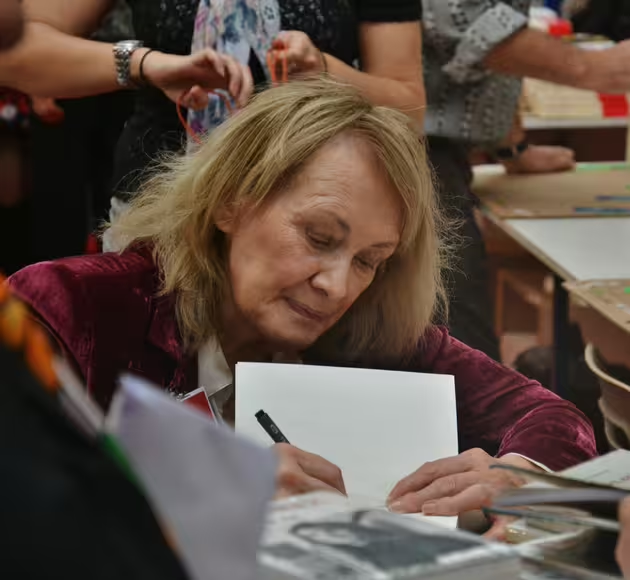
On September 1, 1940, Annie Ernaux was born in Lillebonne, France. She would become one of the most distinctive voices in contemporary literature and, in 2022, the first French woman to receive the Nobel Prize in Literature.
Her writing transformed personal memories into powerful reflections on family, class, gender, education, aging, and the changes that shaped modern French society.
Growing Up in Normandy
Annie Ernaux spent much of her childhood in Yvetot, Normandy.
Her parents came from working-class backgrounds and ran a small grocery shop and café.
The contrast between the world of her childhood and the educated middle-class environment she later entered would become one of the central themes of her writing.
Education Changes Her World
Ernaux studied literature and eventually became a teacher.
Education opened the door to a different social world, but it also created a sense of distance from the culture in which she had grown up.
That movement between social classes became a subject she returned to repeatedly.
Rather than hiding the tension, she made it part of her literary method.
Her First Book
Ernaux published her first novel, Les Armoires vides — translated into English as Cleaned Out — in 1974.
The book already contained many of the themes that would define her later career: social class, education, family expectations, women's lives, and the power of memory.
Over time, her writing became increasingly direct and autobiographical.
A Different Kind of Autobiography
Ernaux does not simply tell stories about herself.
She uses her own experiences as evidence for understanding the society around her.
A family relationship can become a study of class differences. A childhood memory can reveal changing ideas about education. A personal experience can become part of a wider history of women in France.
Her books therefore sit somewhere between memoir, sociology, history, and literature.
Writing About Her Parents
Several of Ernaux's best-known works explore her relationship with her parents.
In A Man's Place, she writes about her father and the social world from which he came.
The book examines both affection and distance, especially the gap that developed as Ernaux gained an education and entered a different social environment.
Her writing is deliberately restrained, allowing ordinary details to reveal larger social divisions.
The Years
One of her most celebrated works is Les Années — The Years, published in France in 2008.
The book follows decades of personal and collective memory, moving from the years after the Second World War into the 21st century.
Ernaux combines photographs, advertisements, popular songs, political events, consumer products, conversations, and everyday experiences.
The result is not simply the autobiography of one woman, but a portrait of an entire generation.
From “I” to “We”
One of the most unusual features of The Years is the way Ernaux moves away from the traditional autobiographical “I.”
Instead, she often writes through a collective perspective.
Individual memory becomes shared memory.
Her own life becomes a way of recording how language, technology, relationships, politics, and everyday habits changed across decades.
Literature From Ordinary Life
Ernaux frequently writes about subjects that might appear too ordinary for major literature.
She has written about supermarkets, photographs, family meals, education, relationships, illness, social embarrassment, and the experience of growing older.
Her work shows how apparently small moments can reveal much larger forces shaping people's lives.
The Nobel Prize in Literature
On October 6, 2022, the Swedish Academy announced that Annie Ernaux had been awarded the Nobel Prize in Literature.
The award recognized the way her writing explores personal memory while exposing the social structures surrounding individual lives.
The honor placed her among the most influential French-language writers of the modern era.
A Historic First
Ernaux also became the first French woman to receive the Nobel Prize in Literature.
By then, she had been publishing for almost half a century.
Her books had been translated into numerous languages and had attracted readers far beyond France.
A Writer of Memory and Society
Annie Ernaux's work demonstrates that autobiography does not have to be limited to the story of a single person.
By examining her own memories with unusual precision, she has documented changing attitudes toward class, women, family, education, and everyday life.
Her personal history becomes part of a much larger social history.
A Life Turned Into Literature
On September 1, 1940, Annie Ernaux was born in a small town in northern France.
Decades later, the experiences of her childhood, education, family, and adult life would become the raw material for books read around the world.
Her career is a reminder that even the most ordinary memories can become extraordinary literature when they reveal something universal about how people live, change, and remember.
Other Events on This Day
- The SR-71 Blackbird Flies from New York to London in Under Two Hours
- The Wreck of Titanic Is Found After 73 Years
Credits: 1st photo by Lucas Destrem — CC BY-SA 3.0 / Wikimedia Commons.