
Oct
25
25
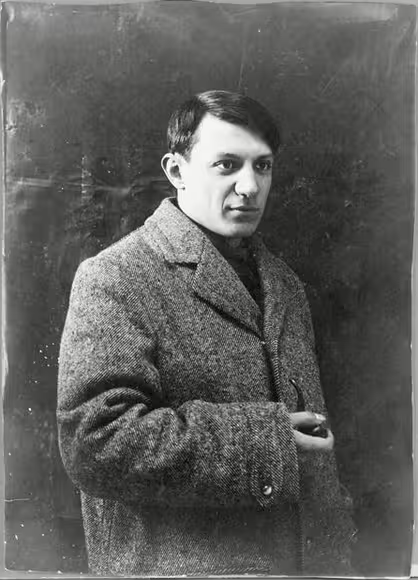
On October 25, 1881, Pablo Picasso was born in Málaga, southern Spain. A painter, sculptor and tireless experimenter, he would become one of the most influential artists of the twentieth century. His work challenged familiar ways of depicting the world and helped open new possibilities for modern art.
From a Spanish Childhood to Paris
Picasso grew up surrounded by art. His father, José Ruiz Blasco, was a painter and drawing teacher who encouraged his son’s early interest in painting. After the family moved to Barcelona in 1895, Picasso studied at the city’s La Lonja art school.
He first visited Paris in 1900 and settled there in 1904. The city brought him into contact with artists, writers and collectors who became part of his creative world. His early career included the Blue Period, followed by the Rose Period, as his subjects and visual language continued to change.
Seeing the World from Several Angles
In 1907, Picasso painted Les Demoiselles d’Avignon, a major turning point in his exploration of the human figure. Soon afterwards, his close collaboration with French painter Georges Braque helped establish Cubism.
Cubist paintings broke figures and objects into interlocking planes and geometric forms. Rather than presenting a subject from one fixed viewpoint, they could bring several perspectives together in a single composition. Familiar objects such as bottles, guitars and tables became opportunities to rethink how pictures represent space.
Picasso and Braque also incorporated everyday materials into their work, helping collage become an important part of modern artistic practice.
A Lifetime of Experimentation
Picasso’s creativity extended far beyond painting. He explored sculpture, printmaking, ceramics and theatrical design, repeatedly changing his approach instead of settling into a single style.
He continued working until his death in Mougins, France, on April 8, 1973. His enduring influence lies in the range of his inventions and his willingness to question what an artwork could look like, how it could be made and what it could express.
Other Events on This Day
- Dirk Hartog Lands off Western Australia and Leaves a Message on a Pewter Plate
- New Fossils Reveal the Extraordinary Size of Sarcosuchus, Africa’s Prehistoric Giant
Credits: 1st photo: Unknown photographer, 1908. Source: RMN–Grand Palais, via Wikimedia Commons. Public domain. Sources: Musée Picasso Paris — Picasso Timeline; Peggy Guggenheim Collection — Pablo Picasso; The Museum of Modern Art — Cubism


