
Oct
24
24
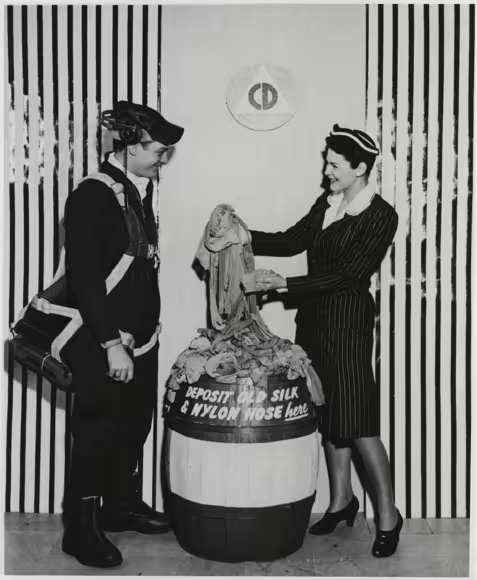
On October 24, 1939, a limited public sale in Wilmington, Delaware, introduced shoppers to a new kind of hosiery: nylon stockings. Around 4,000 pairs sold out in just three hours. Developed through DuPont’s research, the new fibre was about to turn a laboratory achievement into a fashion phenomenon.
From Chemistry to the Stocking Drawer
Before nylon, silk was prized for fine stockings, although it was expensive and easily snagged. Much of America’s silk supply came from Japan. Rayon and other fibres offered alternatives, but manufacturers still sought a material that combined an attractive appearance with greater durability.
At DuPont, Wallace Carothers and his research team explored the chemistry of polymers: large molecules built from repeating units. In 1935, their work produced the material that became known as nylon 6,6. This breakthrough grew out of fundamental chemical research and years of development by scientists and engineers.
DuPont promoted nylon’s strength and delicacy, presenting it as a remarkable fibre derived from coal, air and water. Demonstrations at the 1939 New York World’s Fair helped build excitement before stockings reached the wider market.
A Nationwide Shopping Sensation
The Wilmington sale followed earlier trials involving DuPont employees. Nationwide sales began on May 15, 1940, when shoppers crowded stores to buy the much-publicised stockings. According to the American Chemical Society, nearly 800,000 pairs were sold that first day.
Nylon offered the appeal of sheer hosiery with improved durability, although it was still vulnerable to runs. Its popularity was so immediate that “nylons” became a familiar name for stockings themselves.
Wartime Shortages and Painted-On Stockings
During the Second World War, nylon production was redirected towards military requirements. The fibre went into parachutes, ropes, mosquito netting and tyre reinforcement cords, leaving little available for civilian hosiery.
Stockings became precious possessions, and some supplies reached the black market. Some women used tinted leg cosmetics, often called liquid stockings, to imitate their appearance. A line drawn up the back of each leg with an eyebrow pencil could complete the illusion of a stocking seam.
Why Did Early Nylons Have a Back Seam?
The seam had a practical origin. Traditional fully fashioned stockings were knitted flat, with the number of stitches adjusted to shape the fabric around the leg. The edges were then sewn together at the back.
This construction created the distinctive line associated with mid-century hosiery. Keeping it straight became part of achieving a neat, carefully dressed appearance.
The Return of Nylons
When nylon stockings returned to shops after the war, demand again overwhelmed supplies. The resulting queues and occasional disorder became known as the “nylon riots”. In Pittsburgh in 1946, an estimated 40,000 people competed for just 13,000 pairs.
From the first Wilmington sale to the postwar shopping crowds, nylon demonstrated how quickly a new material could reshape everyday life. Its success helped establish synthetic fibres as an important part of modern clothing and textile manufacturing.
Other Events on This Day
- Annie Edson Taylor Survives Niagara Falls in a Barrel on Her 63rd Birthday
- The United Nations Is Founded as Its Charter Comes into Force
Credits: 1st photo: U.S. Office of War Information, circa 1942. Franklin D. Roosevelt Presidential Library and Museum / U.S. National Archives, NAID 196427, via Wikimedia Commons. Public domain. Sources: Science History Institute — Synthetic Threads; American Chemical Society — Wallace Carothers and the Development of Nylon; Science History Institute — Nylon: A Revolution in Textiles; Smithsonian Magazine — How Nylon Stockings Changed the World; Smithsonian Magazine — Paint-on Hosiery During the War Years; University of Rhode Island, Historic Textile and Costume Collection — Woman’s Stockings


