
Oct
26
26
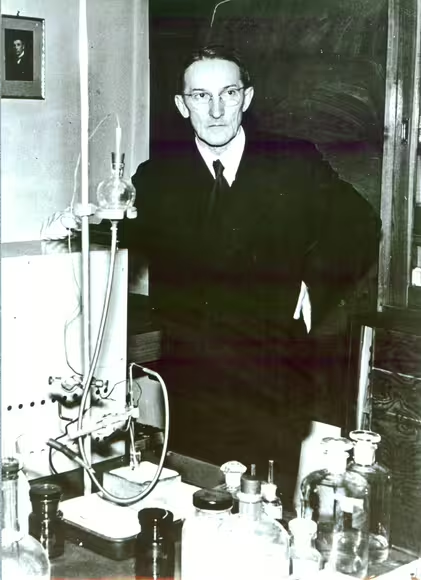
On October 26, 1959, the announcement of the Nobel Prize in Chemistry brought international recognition to Jaroslav Heyrovský. The Czech scientist was honoured for discovering and developing polarographic methods of analysis, which gave chemists a powerful way to identify substances dissolved in liquids and measure their concentrations. He became the first Czech recipient of a Nobel Prize.
A Discovery Hidden in Drops of Mercury
Heyrovský’s breakthrough dated back to 1922. While investigating the behaviour of mercury electrodes, he began measuring how the electric current passing through a solution changed as the applied voltage varied. A stream of tiny mercury drops provided a repeatedly renewed electrode surface, making the measurements highly reproducible.
The resulting curves revealed valuable information about the sample. Their characteristic steps could help identify particular substances, while the height of those steps indicated how much was present. Even small concentrations could be detected.
Turning an Experiment into a Practical Tool
Working with Japanese chemist Masuzo Shikata, Heyrovský developed the polarograph, an instrument that recorded these curves automatically. This made the technique faster and more practical, helping it spread beyond its original laboratory.
Polarography found applications in scientific research and industry, including the analysis of metals, food products and biological samples. Its relatively simple equipment and sensitivity made it an important addition to the chemist’s toolkit. Heyrovský also built a research community around the method and became the founding director of the Polarographic Institute in 1950.
Recognition for a Lifetime of Research
On December 10, 1959, Heyrovský received his Nobel Prize from King Gustaf VI Adolf of Sweden in Stockholm. The ceremony recognised almost four decades of work devoted to understanding and refining his discovery.
His legacy extends beyond the original apparatus. Polarography helped establish approaches to electrochemical analysis that later researchers developed into new techniques, allowing electrical measurements to reveal the composition and behaviour of matter.
Other Events on This Day
- PlayStation 2 Arrives in North America and Begins a Record-Breaking Journey
- The Terminator Arrives in Cinemas and Launches a Science-Fiction Legend
Credits: 1st photo: Archive of the J. Heyrovský Institute of Physical Chemistry, Czech Academy of Sciences, via Wikimedia Commons, CC BY-SA 3.0. Sources: Nobel Prize — The Nobel Prize in Chemistry 1959; Czech Radio — Jaroslav Heyrovský; Czech Academy of Sciences — One Hundred Years of Polarography; Radio Prague International — Jaroslav Heyrovský


