
Oct
2
2
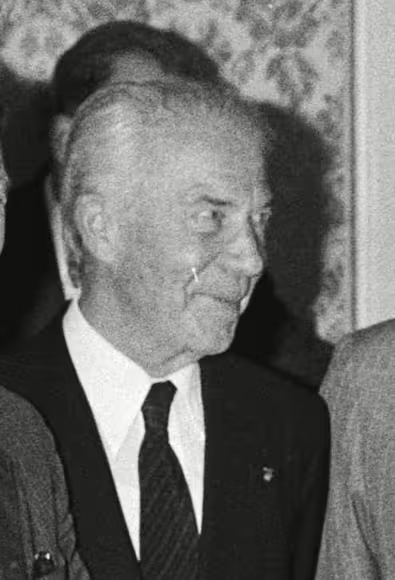
On 2 October 1917, Belgian cell biologist and biochemist Christian de Duve was born in Thames Ditton, England. His parents had taken refuge there during the First World War. His research would later reveal previously unknown compartments inside living cells, helping scientists understand how cells break down materials and organise their chemical activities.
From Medicine to the Inner Life of Cells
After his family returned to Belgium, de Duve grew up in Antwerp. He studied medicine at the Catholic University of Louvain, graduating in 1941, and subsequently earned a degree in chemistry. His interests increasingly drew him towards the biochemical processes that make life possible.
Rather than relying only on what could be seen through a microscope, de Duve investigated cells by separating their components and measuring enzyme activity. This approach allowed him to identify specialised structures through the chemical work they performed.
Discovering the Cell’s Recycling Compartments
In 1955, de Duve and his colleagues described the lysosome, a compartment enclosed by a membrane and containing digestive enzymes. These enzymes break down large molecules and cellular material, allowing useful components to be recovered and reused.
The discovery helped explain how a cell could contain powerful digestive substances without allowing them to damage everything around them. By keeping these enzymes within specialised compartments, cells could control where much of this breakdown occurred.
His research also established the identity of peroxisomes, another group of cellular compartments associated with distinctive chemical reactions. Together, these findings revealed how much could be learned by connecting cell structure with biochemistry.
A Nobel Prize for Exploring the Cell
In 1974, de Duve shared the Nobel Prize in Physiology or Medicine with Albert Claude and George Emil Palade. Their discoveries transformed understanding of the cell’s internal organisation and the functions of its different components.
A Lasting Scientific Legacy
That same year, de Duve founded a research institute in Brussels that later became the de Duve Institute. He championed fundamental research as a foundation for understanding disease. His career demonstrated how careful attention to unexpected experimental results could uncover essential features of life hidden within every cell.
Other Events on This Day
Credits: 1st photo: Rob Croes / Anefo, Nationaal Archief, via Wikimedia Commons. CC0 1.0. Cropped. Sources: de Duve Institute — Our history; Christian de Duve: Explorer of the cell who discovered new organelles by using a centrifuge; Nobel Prize in Physiology or Medicine 1974 — Press release.


