
Oct
1
1
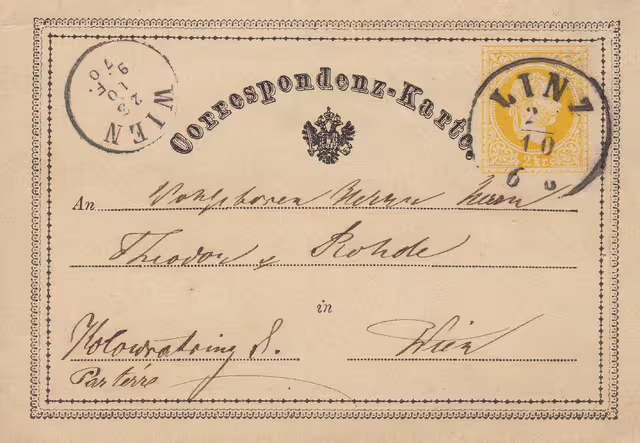
On 1 October 1869, Austria-Hungary introduced the world’s first officially issued postal cards with prepaid postage. Known as Correspondenz-Karten, these simple cards offered an inexpensive way to send a short message without an envelope. Their arrival marked a significant change in everyday written communication.
A Simple Idea with Practical Appeal
The introduction followed a proposal by Austrian economist Emanuel Herrmann, who argued that brief messages could be sent more economically on an open card. Similar ideas had been suggested before, including a proposal by German postal reformer Heinrich von Stephan in 1865.
The innovation lay in turning the idea into an official postal service. Customers could buy a card with postage already printed on it, write their message and the recipient’s address, and send it without preparing a conventional letter.
Communication Without an Envelope
The original cards were plain and practical. One side carried the address and printed postage, while the other provided space for the message. They were designed for everyday correspondence rather than the scenic photographs and holiday greetings later associated with picture postcards.
There was an obvious trade-off: anyone handling the card could read its contents. For routine arrangements, brief news, or business communications, however, many senders found convenience and low cost more important than privacy.
An Immediate Success
The public response was enthusiastic. According to the Austrian postal service’s historical account, 1.4 million cards were sold during the first month. The demand showed that not every message needed the space, formality, or expense of a full letter.
Other countries soon adopted the format. Britain introduced its own postal cards in 1870, with an imprinted halfpenny stamp covering postage at half the price of a letter. Switzerland also introduced postal cards that year.
From Everyday Messages to Lasting Keepsakes
The plain correspondence card helped establish a form of communication that would later develop into the familiar picture postcard. Alongside practical messages came travel views, greetings, and cards collected as souvenirs.
The innovation of 1 October 1869 was modest in appearance but substantial in impact: it made a short written message easier and cheaper to send, bringing postal communication into more everyday exchanges.
Other Events on This Day
- Concorde Breaks the Sound Barrier for the First Time
- The Birth of Charles VI, Father of Maria Theresa
Credits: 1st photo: Austro-Hungarian postal service. Collection and scan: Thmsfrst / Wikimedia Commons. Public domain. Sources: Österreichische Post — History of the Austrian Post; Museumsstiftung Post und Telekommunikation — History of the Postcard; The Postal Museum — Postcards; Swiss Post — The Postcard Since 1870


