Aug
25
25
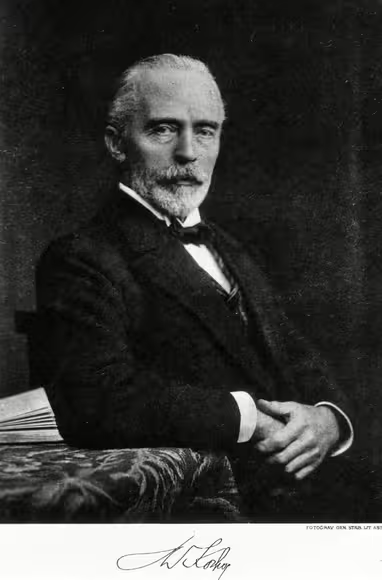
On 25 August 1841, Swiss surgeon and medical researcher Emil Theodor Kocher was born in Bern. His work helped transform surgery into a safer, more systematic discipline and deepened medical understanding of the thyroid gland.
A Career Rooted in Bern
Kocher studied medicine in his native city and qualified in 1865. In 1872, he became professor of surgery at the University of Bern, beginning a long career that combined clinical practice, research and teaching.
He belonged to a generation of surgeons working to reduce the dangers of operations. Careful technique, the prevention of infection and close observation of patients became central to his approach.
Understanding the Thyroid
Kocher’s most influential research concerned the thyroid gland. In the nineteenth century, doctors knew that an enlarged thyroid, or goitre, could cause serious problems, but the gland’s normal function remained poorly understood.
Improving the operation itself was only part of the challenge. Following patients after surgery revealed that removing the entire thyroid could have severe long-term consequences. These observations helped establish that the gland performed an essential role in the body.
Kocher’s work demonstrated the importance of evaluating what happened after a patient left the operating theatre. An apparently successful operation could still cause harm if it removed an organ whose function was not yet understood.
Nobel Recognition
In 1909, Kocher received the Nobel Prize in Physiology or Medicine for his research into the function, diseases and surgical treatment of the thyroid gland.
The award recognised the connection between his practical improvements in surgery and his contribution to medical science. His findings helped shape the emerging study of the body’s hormone-producing organs.
A Lasting Surgical Legacy
Kocher died in Bern on 27 July 1917. He left a legacy built on precision, observation and a willingness to reconsider established methods.
His career illustrates a fundamental lesson in medicine: progress depends on understanding both the immediate results of treatment and its lasting effects on patients’ lives.
Other Events on This Day
- Arpad Elo, Creator of the Elo Rating System, Is Born
- Captain Matthew Webb Swims Across the English Channel
- Galileo Presents His Telescope to the Rulers of Venice
Credits: 1st photo: Unknown photographer / Wikimedia Commons. Public domain. Sources: Journal of the Royal Society of Medicine — Emil Theodor Kocher (1841–1917); NobelPrize.org — Award Ceremony Speech, 1909; University of Bern — Theodor Kocher