Aug
25
25
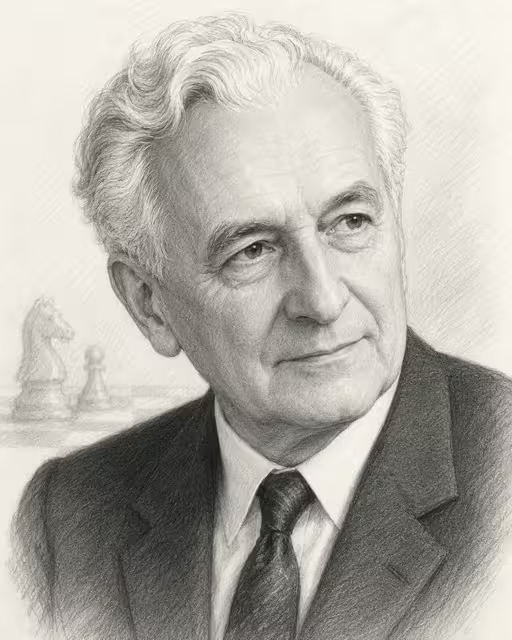
On August 25, 1903, Arpad Elo was born in Hungary. Decades later, his name would become inseparable from one of the most widely used systems for measuring competitive skill.
Today, the term Elo rating is familiar far beyond the world of chess. It is used to compare players, estimate expected results, and track performance over time. But “Elo” is not an acronym — it is the surname of the man who developed the system.
From Hungary to the United States
Arpad Emmerich Elo was born as Élő Árpád Imre on August 25, 1903, in what was then the Kingdom of Hungary within Austria-Hungary.
When he was a child, his family emigrated to the United States and settled in Cleveland, Ohio.
Elo later studied physics at the University of Chicago and became a professor at Marquette University in Milwaukee, where he taught for several decades.
Chess, however, remained one of his great interests.
A Physicist Who Loved Chess
Elo was not only an academic. He was also a strong competitive chess player and an active figure in American chess organizations.
He won the Wisconsin State Chess Championship several times and became involved in efforts to improve the way chess players were ranked.
At the time, rating systems already existed, but they were not always reliable or mathematically consistent. Elo was asked to help develop a better method.
How the Elo Rating Works
Elo's idea was based on a simple principle: a player's rating should reflect not only whether they win or lose, but also how strong their opponent is.
If a highly rated player defeats a much weaker opponent, the result is expected, so the winner gains relatively few points.
If the weaker player wins, however, the result is a surprise. The lower-rated player gains more points, while the higher-rated player loses more.
Over time, the system continuously adjusts ratings based on actual performance.
In simple terms, an Elo rating is not just a record of past victories. It is an estimate of a player's strength compared with everyone else in the rating pool.
From American Chess to the World
The United States Chess Federation adopted Elo's system in 1960.
Its influence grew quickly, and in 1970 the international chess federation FIDE officially adopted the Elo rating system for international competition.
From that point on, Elo ratings became the standard way of comparing elite chess players around the world.
The system made it possible to express playing strength with a single number and to estimate the expected result of a match between two players.
Elo Is a Name, Not an Acronym
One of the most common misconceptions about the rating system is the spelling “ELO.”
It may look like an abbreviation, but it is simply Arpad Elo's surname.
That means a phrase such as “an Elo rating of 1800” is, in a very literal sense, still carrying the name of the Hungarian-American physicist who designed the system more than half a century ago.
Far Beyond Chess
Although Elo created his rating system for chess, its basic idea proved useful in many other competitive environments.
Variations of Elo-style ratings have been used in sports, board games, online games, esports, and other systems where competitors repeatedly face one another and their relative strength needs to be estimated.
The original formula has been modified many times, but the central idea remains the same: performance should be judged relative to the strength of the opponent.
A Name That Became a Measure of Skill
Arpad Elo died in 1992, but his name continues to appear every day on tournament rankings, chess websites, gaming platforms, and statistical models around the world.
His story is a rare example of a person's surname becoming an everyday technical term.
On August 25, 1903, a future physicist and chess player was born in Hungary. More than a century later, millions of competitors still measure their skill using the system that bears his name.
Other Events on This Day
- Captain Matthew Webb Swims Across the English Channel
- Galileo Presents His Telescope to the Rulers of Venice
- The Birth of Emil Theodor Kocher, a Pioneer of Modern Surgery