Aug
25
25
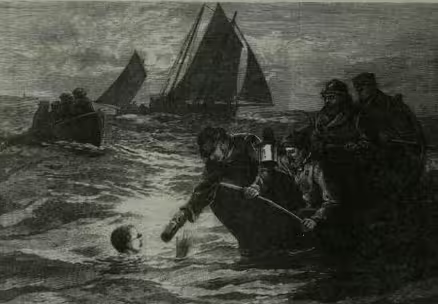
On August 25, 1875, Captain Matthew Webb reached the coast of France after swimming across the English Channel from England. After spending 21 hours and 45 minutes in the water, he became the first person to complete the crossing without artificial flotation assistance.
His achievement turned him into an international celebrity and helped establish long-distance open-water swimming as a serious endurance sport.
A Challenge Few Believed Possible
In the 19th century, the English Channel was already one of Europe's busiest and most difficult stretches of water.
At its narrowest point, the distance between England and France is about 21 miles, or 34 kilometres.
But strong tides, cold water, waves, and constantly changing currents make the actual swimming distance much longer.
For most people at the time, swimming across the Channel seemed almost impossible.
Who Was Matthew Webb?
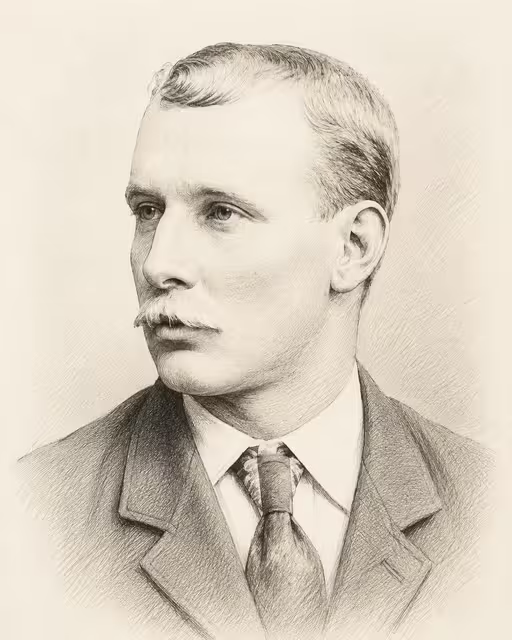
Matthew Webb was born in Shropshire, England, in 1848.
He went to sea at a young age and eventually became a captain in the merchant navy.
Webb was already known as a powerful swimmer before his Channel attempt. His experience at sea gave him a strong understanding of currents, weather, and the physical demands of long periods in cold water.
A First Attempt Ends in Failure
Webb did not succeed on his first try.
On August 12, 1875, he entered the water in an attempt to reach France, but difficult weather and sea conditions forced him to abandon the swim.
Instead of giving up, he returned less than two weeks later and tried again.
Leaving Dover
On August 24, 1875, Webb entered the water near Admiralty Pier in Dover shortly before 1 p.m.
A support boat accompanied him, but he was not allowed to use it for physical assistance.
He had to rely entirely on his own swimming ability.
During the crossing, he was given food and drink from the accompanying boat, but he remained in the water throughout the attempt.
Swimming Through the Night
The swim continued through the afternoon, evening, and entire night.
Webb had to deal with cold water, fatigue, waves, and powerful Channel currents.
At one point, he was reportedly stung by a jellyfish, but continued swimming.
The tides repeatedly pushed him away from a direct route, meaning he covered far more than the Channel's minimum width.
Estimates suggest that he may have swum roughly 38 to 40 miles during the crossing.
France at Last
After 21 hours and 45 minutes in the water, Webb finally reached the French coast near Calais on the morning of August 25, 1875.
He had completed something that many people thought could not be done.
His successful crossing immediately attracted enormous public attention.
An International Celebrity
Webb returned to Britain as a hero.
Newspapers celebrated his endurance, courage, and determination, and he quickly became one of the best-known sporting figures of his time.
His achievement also inspired generations of swimmers to attempt the same crossing.
The English Channel later became one of the world's most famous endurance swimming challenges.
Why His Record Mattered
Webb was not the first person to cross the Channel in any way.
Earlier in 1875, American adventurer Paul Boyton had crossed using a special buoyant survival suit and a paddle.
Webb's achievement was different.
He crossed by swimming without artificial flotation assistance, making his performance the foundation of modern Channel swimming.
“Nothing Great Is Easy”
A phrase closely associated with Matthew Webb later became:
“Nothing Great Is Easy.”
The words perfectly summarize the spirit of his Channel crossing.
His success came only after failure, hours of exhaustion, changing currents, and a night spent alone in cold open water.
A Landmark in Endurance Sport
Captain Matthew Webb's swim across the English Channel was more than a sporting record.
It demonstrated what disciplined training, determination, and physical endurance could achieve at a time when long-distance swimming was still in its infancy.
On August 25, 1875, Webb stepped out of the Channel on the French coast and into sporting history.
Other Events on This Day
- Arpad Elo, Creator of the Elo Rating System, Is Born
- Galileo Presents His Telescope to the Rulers of Venice
- The Birth of Emil Theodor Kocher, a Pioneer of Modern Surgery
Credits: 1st photo by unknown artist — Public Domain / Wikimedia Commons.