Aug
24
24
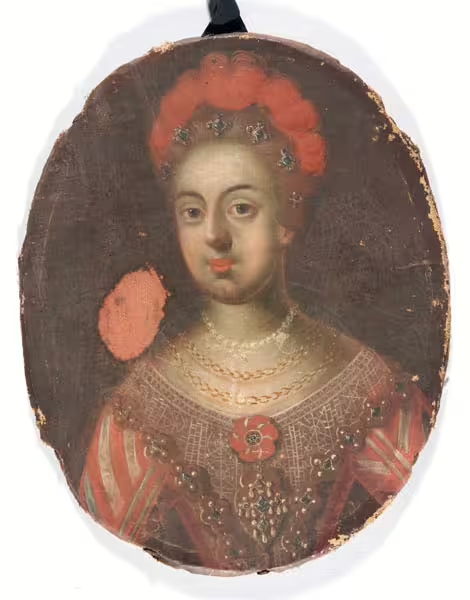
On August 24, 1510, Elisabeth of Brandenburg was born into one of the most powerful dynasties of the Holy Roman Empire. She would later become Duchess of Brunswick-Calenberg-Göttingen, a regent, writer, and influential supporter of the Protestant Reformation.
Although she is far less famous today than many rulers of the 16th century, Elisabeth played an important political and religious role in northern Germany.
Born Into the House of Hohenzollern
Elisabeth was born into the House of Hohenzollern, the ruling family of Brandenburg.
Her father was Elector Joachim I of Brandenburg, while her mother, Elisabeth of Denmark, was the daughter of a Danish king.
From birth, Elisabeth belonged to a network of royal and princely families that connected much of northern Europe.
A Very Young Duchess
In 1525, before she had even reached her fifteenth birthday, Elisabeth married Eric I, Duke of Brunswick-Lüneburg.
Her husband was roughly forty years older than she was.
The couple had four children, including their son Eric II, who would later inherit the duchy.
Like many aristocratic marriages of the period, the union was closely connected to dynastic and political interests.
Turning Toward the Reformation
The Protestant Reformation was transforming Europe during Elisabeth's lifetime.
Her mother had become sympathetic to the teachings of Martin Luther, and Elisabeth gradually moved in the same direction.
In 1538, she publicly declared her commitment to Lutheran Christianity.
Her husband remained Catholic, but he largely tolerated her religious position during his lifetime.
Becoming Regent
When Eric I died in 1540, their son was still too young to rule independently.
Elisabeth therefore became regent of Brunswick-Calenberg-Göttingen.
For the first time, she had direct authority over the government of the territory.
She used that authority not only to manage the duchy, but also to introduce significant religious and administrative reforms.
Bringing the Reformation to Her Territory
Elisabeth worked closely with the Lutheran theologian Antonius Corvinus.
Together, they helped reorganize churches, introduce Protestant teaching, and reform religious institutions across the duchy.
By the early 1540s, the Reformation was being systematically established throughout much of her territory.
Her role was so important that she is sometimes remembered as a “Reformation princess.”
More Than a Religious Reformer
Elisabeth's regency was not limited to church affairs.
She also supported reforms in areas such as poor relief, court administration, and the legal system.
Her government reflected the broader changes taking place across Europe, where religious reform was often closely connected with changes in education, administration, and social policy.
A Writer and Adviser
Elisabeth was also an active writer.
She produced religious texts, prayers, songs, and practical advice for members of her family.
One of her most interesting works was a set of instructions for her son on how to govern responsibly.
Among other things, she warned him against unnecessary spending and expensive wars.
She also wrote guidance for her daughter on marriage and composed texts intended for widows.
These writings provide a rare glimpse into how a politically experienced woman of the 16th century thought about government, family, religion, and personal responsibility.
A Difficult Relationship With Her Son
Elisabeth had raised her son Eric II as a Protestant, but after taking control of the duchy he eventually returned to Catholicism.
This created political and religious tensions between mother and son.
As Eric became more independent, Elisabeth gradually lost much of the influence she had exercised during her regency.
She spent the later years of her life away from the center of power she had once governed.
A Lasting Legacy
Elisabeth died in 1558 at the age of 47.
Her life reflected many of the defining changes of 16th-century Europe: dynastic politics, religious reform, changing ideas about government, and the growing importance of education and written advice.
Born on August 24, 1510, Elisabeth of Brandenburg became far more than a noblewoman by birth.
She governed, wrote, reformed institutions, and helped shape the religious future of her territory at a time when political power was still overwhelmingly dominated by men.
Other Events on This Day
- Amelia Earhart Flies Nonstop Across America
- The First Concrete Is Poured for the Panama Canal's Gatun Locks
Credits: 1st photo: Kunstsammlungen der Veste Coburg — Public Domain / Wikimedia Commons.