Aug
24
24
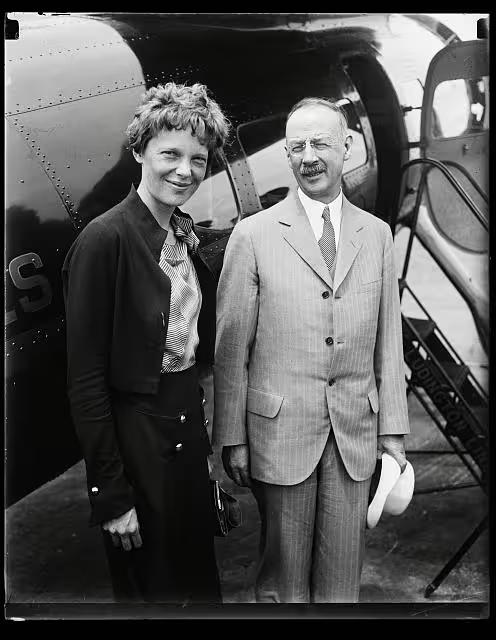
On August 24, 1932, Amelia Earhart took off from Los Angeles on a historic solo flight across the United States. When she landed in Newark, New Jersey, the following day, she became the first woman to fly solo and nonstop from coast to coast.
The journey covered nearly 2,450 miles and took just over 19 hours, adding another major aviation record to Earhart's growing list of achievements.
A Pilot Already Making History
By 1932, Amelia Earhart was already one of the most famous aviators in the world.
In 1928, she had become the first woman to cross the Atlantic Ocean by airplane as a passenger.
Four years later, in May 1932, she made an even more important flight: she became the first woman to fly solo and nonstop across the Atlantic.
That achievement made her an international celebrity and proved that she was not simply a symbolic figure in aviation, but a highly capable long-distance pilot.
Across the United States
Only a few months after her Atlantic crossing, Earhart attempted another demanding record.
On August 24, 1932, she departed Los Angeles, California, and headed east toward Newark, New Jersey.
Her goal was to cross the entire continental United States without stopping.
At a time when aviation was still relatively young, such a journey required endurance, careful navigation, mechanical reliability, and the ability to cope with changing weather over thousands of miles.
The Lockheed Vega
Earhart flew a Lockheed Vega 5B, the same type of aircraft associated with several of her most famous record-setting flights.
The Vega was a fast, single-engine monoplane designed for long-distance travel.
Its streamlined wooden construction and powerful engine made it one of the most advanced civilian aircraft of its era.
For Earhart, it became a machine closely connected with her reputation as one of the leading pioneers of modern aviation.
More Than 19 Hours in the Air
The transcontinental flight lasted approximately 19 hours and 5 minutes.
Earhart covered roughly 2,448 miles before reaching Newark on August 25.
The flight established a new women's nonstop transcontinental record and made her the first woman to fly solo and nonstop across the United States.
It was another demonstration of how quickly aviation was changing during the early 20th century.
Breaking More Than Aviation Records
Earhart's achievements had significance far beyond flying.
Aviation in the 1920s and 1930s was still heavily dominated by men, and female pilots often faced doubts about whether they could compete at the highest levels of the profession.
Earhart used her visibility to encourage more women to enter aviation and other careers traditionally considered unsuitable for them.
She also helped establish The Ninety-Nines, an international organization for female pilots, and later served as its first elected president.
Another Record the Following Year
Earhart was not finished with the transcontinental route.
In July 1933, she flew across the United States nonstop again and improved her own record, completing the journey in about 17 hours and 7 minutes.
Her repeated record attempts reflected a constant desire to push both aircraft and pilots beyond what had previously been considered possible.
A Symbol of the Aviation Age
During the following years, Earhart continued setting records.
In 1935, she became the first person to fly solo from Hawaii to the continental United States, traveling from Honolulu to Oakland, California.
She also completed pioneering solo flights between Los Angeles and Mexico City and between Mexico City and Newark.
Each achievement helped make long-distance aviation seem less extraordinary and more like a glimpse of the future of transportation.
A Flight That Inspired Generations
Amelia Earhart disappeared over the Pacific Ocean in 1937 while attempting to fly around the world, creating one of aviation history's most enduring mysteries.
But her legacy was already firmly established long before her final flight.
On August 24, 1932, she set out across the United States alone, remaining in the air for more than nineteen hours before reaching the opposite coast.
The achievement was another important step in the development of long-distance aviation — and another barrier broken by one of the most famous pilots of the 20th century.
Other Events on This Day
- Elisabeth of Brandenburg, Reformer and Regent, Is Born
- The First Concrete Is Poured for the Panama Canal's Gatun Locks
Credits: 1st photo by Harris & Ewing / Library of Congress. No known restrictions on publication.