Aug
24
24
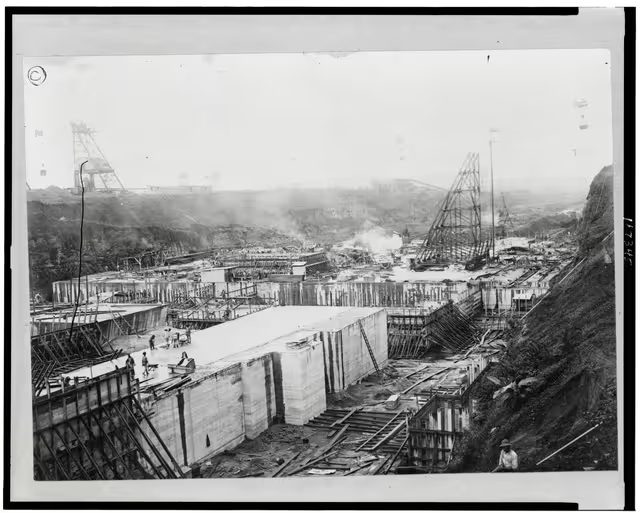
On August 24, 1909, workers began pouring concrete for the massive Gatun Locks of the Panama Canal — one of the most ambitious engineering projects of its time.
The Panama Canal had already been under American construction for several years, but the beginning of concrete work at Gatun marked an important new stage. The locks would become a crucial part of the canal, allowing ships to cross the mountainous interior of Panama instead of following a canal built entirely at sea level.
A Giant Elevator for Ships
The Panama Canal works by lifting ships from sea level to Gatun Lake, about 26 meters above the ocean, and then lowering them again on the opposite side.
The locks act like enormous water-powered elevators. Ships enter a chamber, huge gates close behind them, and water flows in or out to raise or lower the vessel.
At Gatun, engineers had to build enormous concrete chambers capable of handling some of the largest ships in the world at the time.
Concrete on an Unprecedented Scale
Pouring concrete for the locks was a major engineering challenge. Large-scale concrete construction was still relatively new, and the Panama Canal required quantities rarely seen before.
Cement, sand, gravel, and stone had to be transported to the construction sites, mixed in enormous quantities, and moved into position using specially designed equipment, including cableways capable of carrying several tons of material at once.
Concrete work later began at the Pedro Miguel and Miraflores locks as well. Over the following years, approximately 4.5 million cubic yards of concrete were used in the canal's lock structures.
Thousands of Workers Built the Canal
The Panama Canal was built by a huge international workforce.
By 1909, tens of thousands of people were working on the project. Many laborers came from the Caribbean, especially Barbados and other islands of the British West Indies. Others arrived from the United States and Europe.
The work was physically demanding and often dangerous. Workers faced tropical heat, heavy machinery, landslides, accidents, and diseases such as malaria.
Improved sanitation and mosquito-control programs were therefore just as important to the project's success as the engineering itself.
From Construction Site to Global Waterway
The lock construction continued for several years. By 1913, most of the major concrete work had been completed and engineers began testing the new system.
On August 15, 1914, the Panama Canal officially opened to commercial traffic.
The new waterway connected the Atlantic and Pacific Oceans through Panama, dramatically shortening many shipping routes. Ships traveling between the east and west coasts of the Americas no longer had to sail thousands of additional kilometers around South America's Cape Horn.
An Engineering Landmark
The first concrete poured at Gatun on August 24, 1909, may seem like a small moment in the history of the canal, but it marked the beginning of one of its most important construction phases.
The enormous lock system transformed the Panama Canal from an excavation project into a functioning piece of machinery capable of moving ocean-going ships across a continent.
More than a century later, the Panama Canal remains one of the world's most important shipping routes — and the original locks built during this period continue to stand as a remarkable achievement of early 20th-century engineering.
Other Events on This Day
Credits: 1st photo by Library of Congress / Wikimedia Commons — Public Domain