Sep
3
3
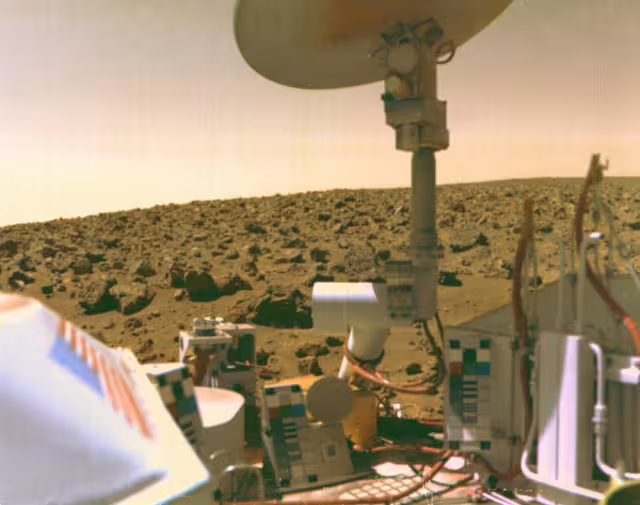
On September 3, 1976, NASA's Viking 2 lander successfully touched down on Mars. Its arrival marked another major step in humanity's exploration of the Red Planet and began a scientific mission designed to study the Martian surface, atmosphere, weather, and the possibility of life.
Viking 2 followed Viking 1, which had landed on Mars only six weeks earlier.
A Mission to Explore Mars
The Viking program was one of NASA's most ambitious planetary missions of the 1970s.
Two spacecraft — Viking 1 and Viking 2 — were sent to Mars.
Each consisted of an orbiter that remained above the planet and a lander designed to descend safely to the surface.
Together, they were intended to provide scientists with an unprecedented view of Mars from both orbit and ground level.
Touchdown on September 3
Viking 2 landed successfully on September 3, 1976.
Its landing site was in Utopia Planitia, an enormous plain in the northern hemisphere of Mars.
The region was significantly farther north than Viking 1's landing site and offered scientists an opportunity to study a different Martian environment.
A Rocky Alien Landscape
The first images from Viking 2 revealed a cold, rocky landscape covered with stones of many sizes.
The surface appeared flat in the distance, while the immediate surroundings were surprisingly rough.
For people on Earth, the photographs provided another extraordinary opportunity to see the surface of another planet from ground level.
Searching for Life
One of the most important goals of the Viking missions was to investigate one of humanity's oldest questions:
Could life exist on Mars?
Viking 2 carried a small laboratory containing biological experiments designed to examine samples of Martian soil.
The experiments looked for chemical reactions that might indicate the presence of microorganisms.
A Scientific Mystery
The biological experiments produced intriguing results.
Some tests detected unexpected chemical activity in the Martian soil, leading to intense scientific debate.
However, the overall results did not provide convincing proof that living organisms had been discovered.
Scientists concluded that unusual chemical processes in the soil could explain many of the observations.
The question of whether Mars has ever supported life therefore remained open.
Studying Martian Weather
Viking 2 was also a weather station on another world.
Its instruments measured temperature, wind speed, wind direction, and atmospheric pressure.
These observations helped scientists understand the daily and seasonal changes taking place in the thin Martian atmosphere.
Frost on Mars
One of Viking 2's most memorable discoveries came during the Martian winter.
The lander photographed frost covering parts of the surrounding landscape.
The images offered dramatic evidence of the extremely cold conditions at its northern landing site and helped researchers study the movement of water and carbon dioxide through the Martian environment.
Built for Months, Active for Years
The Viking landers were originally expected to operate for only a few months.
Instead, Viking 2 continued communicating with Earth for more than three and a half years.
Its final transmission was received in April 1980.
The unexpectedly long mission gave scientists far more information about Mars than originally planned.
Mapping an Entire Planet
While the landers studied the surface, the Viking orbiters photographed Mars from above.
Together, the Viking spacecraft produced detailed images covering most of the planet.
They revealed volcanoes, enormous canyons, ancient channels, impact craters, polar regions, and landscapes shaped by geological processes over billions of years.
These observations transformed scientific understanding of Mars.
A Foundation for Future Missions
The Viking program became a foundation for later exploration of the Red Planet.
Decades later, missions including Mars Pathfinder, Spirit, Opportunity, Curiosity, and Perseverance continued many of the questions first investigated by Viking.
Modern missions have far more advanced instruments, but they still build upon knowledge gathered by the pioneering spacecraft of the 1970s.
The Search Continues
Viking 2 did not discover definitive evidence of Martian life.
But its experiments helped shape the way scientists think about searching for life beyond Earth.
Today, researchers continue to investigate whether Mars once had environments capable of supporting microorganisms and whether traces of ancient life may still be preserved in its rocks.
A Laboratory on Another World
On September 3, 1976, Viking 2 became a working scientific laboratory sitting on the surface of another planet.
From its lonely position on Mars, it photographed the landscape, monitored the weather, analyzed the soil, and searched for signs of life.
Its mission helped turn Mars from a distant point of light into a world that humanity could explore directly — one experiment, one photograph, and one transmission at a time.
Other Events on This Day
- Frank Macfarlane Burnet, the Scientist Who Helped Explain How Immunity Works, Is Born
- The World's Oldest Republic Begins on Monte Titano
Credits: 1st photo by NASA/JPL — NASA imagery, generally not subject to copyright in the United States.