Sep
3
3
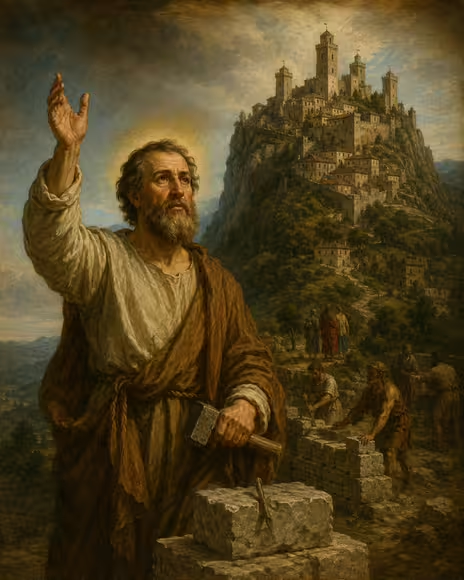
According to tradition, on September 3, 301, a Christian stonemason named Marinus established a small community on Monte Titano. That settlement would eventually become the Republic of San Marino, today widely regarded as the world's oldest surviving republic.
The story combines legend, religion, geography, and one of the most remarkable examples of political continuity in European history.
Who Was Saint Marinus?
Marinus is traditionally described as a Christian stonemason who came from the island of Rab, in the Adriatic Sea.
According to later accounts, he travelled to the Italian peninsula during the reign of the Roman emperor Diocletian.
At a time when Christians could still face persecution, Marinus sought refuge in the hills around Monte Titano.
A Community on the Mountain
Tradition holds that Marinus founded a small Christian community on Monte Titano on September 3, 301.
The date is not documented in the way a modern state foundation would be, but it became central to San Marino's national identity.
Today, September 3 is celebrated as the Feast of Saint Marinus and Foundation of the Republic.
From Religious Community to Independent State
The settlement did not immediately become a republic in the modern sense.
Its institutions developed gradually over many centuries.
The isolated position of Monte Titano helped the community preserve a high degree of autonomy while larger powers rose and fell around it.
Over time, local self-government became an increasingly important part of San Marino's identity.
The World's Oldest Surviving Republic
San Marino is widely described as the oldest surviving republic in the world.
Its claim rests on the traditional foundation date of 301 and on the remarkable continuity of its independent political institutions.
Although those institutions changed over time, San Marino maintained a separate civic identity through periods when much of the Italian peninsula was divided among kingdoms, duchies, city-states, and foreign empires.
Government by Two Captains Regent
One of San Marino's most distinctive traditions is its system of two heads of state.
The country is governed by two Captains Regent, who serve together and are elected for six-month terms.
The institution developed during the medieval period and remains in use today.
This unusually short and shared term of office reflects San Marino's long tradition of limiting individual political power.
A Tiny Country Surrounded by Italy
Modern San Marino covers only about 61 square kilometres.
It is completely surrounded by Italy and is one of Europe's smallest independent states.
Despite its size, it has its own government, laws, national institutions, stamps, coins, and diplomatic relations.
Surviving Napoleon
San Marino's independence survived one of Europe's greatest periods of political upheaval.
When Napoleon Bonaparte reshaped much of the Italian peninsula in the late 18th and early 19th centuries, San Marino remained independent.
According to tradition, Napoleon even respected the small republic and offered to expand its territory.
San Marino declined, preferring to preserve its existing borders rather than risk becoming involved in larger territorial disputes.
Surviving Italian Unification
During the 19th century, the movement to unify Italy threatened the existence of many small independent states.
San Marino nevertheless survived.
One reason was its reputation as a refuge for political exiles and supporters of Italian unification.
The revolutionary leader Giuseppe Garibaldi was among those who found temporary protection there.
Monte Titano and the Three Towers
The visual symbol of San Marino is Monte Titano, the mountain around which the republic developed.
Three medieval towers — Guaita, Cesta, and Montale — rise along its ridge.
They once formed part of the country's defensive system and today remain among its most recognizable landmarks.
A UNESCO World Heritage Site
In 2008, the historic centre of San Marino and Monte Titano were added to the UNESCO World Heritage List.
UNESCO recognized the site as an exceptional example of the continuity of an independent republic over many centuries.
The designation includes the historic city, defensive towers, walls, public buildings, and religious monuments.
More Than Seventeen Centuries of Tradition
Modern San Marino is very different from the small community associated with Saint Marinus.
Yet the republic still celebrates the story of its origins every September 3.
The traditional foundation date has become a symbol of independence, civic identity, and political continuity.
A Small Community With an Extraordinary Legacy
According to tradition, the story began on September 3, 301, when Marinus established a community on the slopes of Monte Titano.
What followed was not the instant creation of a modern state, but the gradual development of a society determined to govern itself.
More than seventeen centuries later, San Marino remains independent — a tiny republic whose survival is one of the most unusual stories in European political history.
Other Events on This Day
- Frank Macfarlane Burnet, the Scientist Who Helped Explain How Immunity Works, Is Born
- Viking 2 Lands on Mars and Begins Searching for Life