Sep
3
3
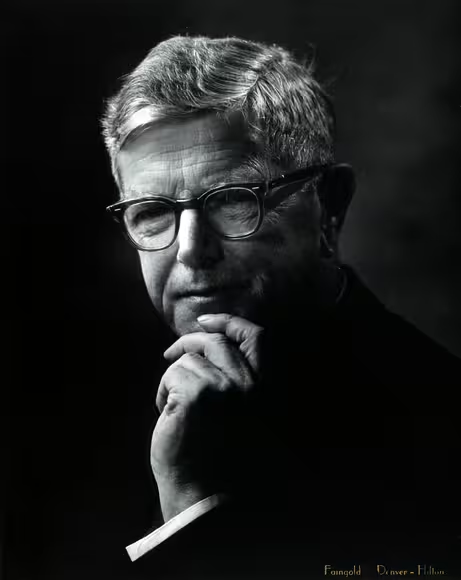
On September 3, 1899, Frank Macfarlane Burnet was born in Traralgon, Victoria, Australia. He would become one of the most influential virologists and immunologists of the 20th century, helping scientists understand how the immune system distinguishes between the body's own tissues and foreign threats.
His work transformed modern immunology and eventually earned him the Nobel Prize in Physiology or Medicine.
From Rural Australia to Medical Science
Burnet grew up in Australia and studied medicine at the University of Melbourne.
He developed an early fascination with infectious disease and microorganisms, eventually focusing his research on viruses and the body's response to infection.
Much of his scientific career was spent at the Walter and Eliza Hall Institute in Melbourne, which became one of Australia's leading centres of medical research.
A Pioneer of Virology
Burnet initially became known for his work in virology.
He studied influenza, bacteriophages, and the ways viruses reproduce and spread.
He was particularly interested in understanding infectious disease not simply as an isolated medical problem, but as part of a larger interaction between viruses, hosts, and populations.
This approach helped shape the emerging science of virus ecology.
A Fundamental Question About Immunity
Burnet later turned his attention to one of biology's most important mysteries:
How does the immune system know what to attack?
The human body contains countless different molecules and cells. An effective immune system must recognize dangerous foreign material while avoiding attacks on the body's own tissues.
Understanding how this discrimination develops became one of Burnet's central scientific interests.
Immunological Tolerance
Burnet proposed that the immune system learns during early development to recognize the body's own tissues as normal.
Once this recognition is established, immune cells generally do not attack those tissues.
This phenomenon became known as acquired immunological tolerance.
The idea helped explain why the immune system normally avoids attacking the body itself and opened new ways of thinking about transplantation and autoimmune disease.
From Theory to Experiment
Burnet's ideas about immune tolerance were later supported by experimental work, particularly by British scientist Peter Medawar and his colleagues.
The experiments showed that under certain conditions an immune system could be taught to accept foreign tissue rather than reject it.
This research became highly important for the future development of organ transplantation.
The Nobel Prize
In 1960, Burnet and Peter Medawar shared the Nobel Prize in Physiology or Medicine.
The prize recognized their discovery of acquired immunological tolerance.
The work provided a new framework for understanding how immune responses develop and why the body accepts some cells while attacking others.
The Clonal Selection Theory
Burnet also helped develop one of the central ideas of modern immunology: the clonal selection theory.
The theory proposes that the immune system contains enormous numbers of different immune cells, each capable of recognizing a particular molecular target.
When a foreign substance enters the body, the cells that recognize it are selected and begin multiplying.
Their descendants then produce a highly targeted immune response.
An Army With Millions of Specialists
A simple way to imagine Burnet's idea is to think of the immune system as an enormous army containing millions of specialists.
Most remain inactive until the particular threat they are designed to recognize appears.
When that happens, the appropriate cells rapidly multiply and respond.
This concept helped explain both the extraordinary precision of immunity and the body's ability to remember previous infections.
Why His Work Still Matters
Burnet's ideas helped build the foundations of modern research into vaccines, organ transplantation, autoimmune diseases, infectious disease, and immune memory.
Scientists continue to use principles derived from clonal selection and immune tolerance when studying how the body reacts to infections, cancers, transplanted organs, and medical treatments.
His theoretical work therefore became deeply connected to practical medicine.
A Virologist Who Changed Immunology
One of the most interesting aspects of Burnet's career is that much of his experimental research focused on viruses.
Yet his most famous legacy came from ideas about the immune system.
His ability to move between virology, medicine, and theoretical biology allowed him to see connections that were not always obvious to other researchers.
An Australian Scientific Legacy
Burnet became one of Australia's most internationally respected scientists.
He was knighted for his contributions to medical research and received numerous scientific honours during his lifetime.
His success also helped demonstrate that internationally important biomedical research could be carried out in Australia, strengthening the country's scientific institutions and reputation.
Understanding the Body's Defences
Frank Macfarlane Burnet died in 1985, but many of the concepts he helped establish remain central to immunology.
Born on September 3, 1899, he spent his career investigating viruses and the remarkable system that protects the human body from disease.
His work helped answer one of medicine's most fundamental questions: how the immune system can recognize an enemy while leaving the body's own cells largely unharmed.
Other Events on This Day
- The World's Oldest Republic Begins on Monte Titano
- Viking 2 Lands on Mars and Begins Searching for Life
Credits: 1st photo by Denver Faingold / Wellcome Collection — CC BY 4.0 / Wikimedia Commons.