
Sep
28
28
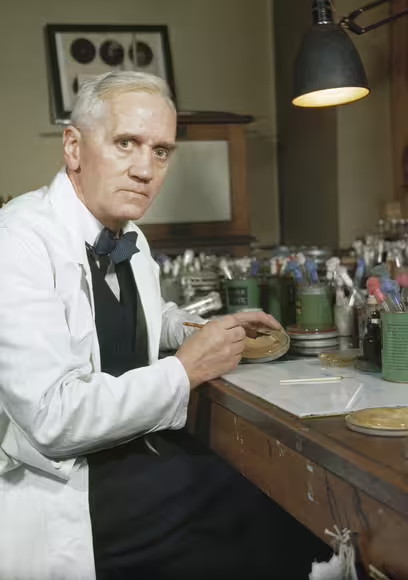
28 September is widely commemorated as the anniversary of Alexander Fleming’s discovery of penicillin in 1928. Although accounts differ on the precise day of his observation, the discovery that September became a turning point in the history of medicine.
At St Mary’s Hospital in London, the Scottish bacteriologist noticed something unusual in a Petri dish containing Staphylococcus bacteria. A contaminating mould had grown on the dish, and the area around it was clear of bacterial growth.
An Unexpected Clue
A contaminated culture might ordinarily have been discarded. Fleming instead investigated why the bacteria near the mould had disappeared. He found that the mould produced a substance capable of killing or inhibiting certain bacteria.
He named the substance penicillin, after the Penicillium mould that produced it, and published his findings in 1929. Chance had provided the clue, but observation and experimental work turned it into a scientific discovery.
From Laboratory Finding to Medicine
Penicillin did not immediately become a practical treatment. Producing a stable, sufficiently pure supply proved difficult, and more than a decade separated Fleming’s observation from its development into an effective medicine.
At the University of Oxford, a team including Howard Florey, Ernst Boris Chain and Norman Heatley developed methods to extract, purify and test penicillin. Their work around 1940 and 1941 demonstrated its promise against serious bacterial infections.
Making enough of the drug presented another challenge. Collaboration between researchers, governments and manufacturers in Britain and the United States greatly expanded production during the Second World War.
A Shared Achievement
In 1945, Fleming, Florey and Chain jointly received the Nobel Prize in Physiology or Medicine for the discovery of penicillin and its therapeutic effects against infectious diseases.
Penicillin helped transform infections that had often been fatal into treatable conditions and became a cornerstone of the antibiotic era. Its history brings together an unexpected laboratory observation, years of research and the industrial effort needed to make a medicine widely available.
Other Events on This Day
- The Birth of Brigitte Bardot, Film Star and Animal Advocate
- The Murchison Meteorite Brings Clues to Life’s Chemical Origins
Credits: 1st photo: Ministry of Information official photographer / Imperial War Museums, TR 1468, via Wikimedia Commons. Public domain. Sources: American Chemical Society – Discovery and Development of Penicillin; National Museum of Australia – Penicillin; NobelPrize.org – The Nobel Prize in Physiology or Medicine 1945


