
Sep
28
28
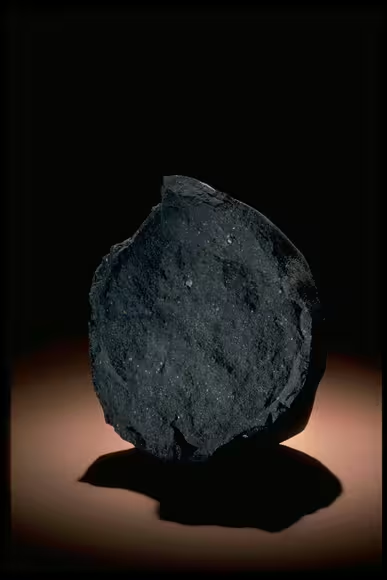
On 28 September 1969, a space rock broke apart in the atmosphere above Murchison, Victoria, Australia. Fragments scattered across the surrounding countryside, delivering material that would become exceptionally valuable to science. Within these dark pieces of rock, researchers found a remarkable variety of organic compounds, including amino acids.
A Scientific Treasure Falls to Earth
The meteorite fell around 160 kilometres north of Melbourne, spreading fragments over roughly 35 square kilometres. Around 100 kilograms of material were eventually collected, with samples distributed to museums and research institutions.
Because people witnessed the fall and pieces were recovered soon afterwards, scientists could examine relatively fresh material. This was particularly useful when investigating organic compounds, which can be difficult to distinguish from contamination introduced after a meteorite reaches Earth.
Chemistry from Beyond Earth
Murchison belongs to a group of meteorites called carbonaceous chondrites. These contain carbon-bearing material that offers clues to chemical processes in the early Solar System.
Studies published from 1970 onwards revealed amino acids and other organic substances in its fragments. Amino acids are best known as the building blocks of proteins, although many varieties found in meteorites are not used to build proteins in living organisms.
Researchers examined the molecules’ chemical characteristics and, in later studies, their isotopic composition. Together, these investigations provided strong evidence that many of the compounds originated beyond Earth.
Ingredients for Life, Not Evidence of Life
In chemistry, “organic” does not mean “produced by a living organism.” Organic molecules can form through non-biological processes. The compounds in Murchison therefore did not demonstrate that the meteorite had carried living things.
Instead, they supported an important possibility: meteorites could have delivered some of the chemical ingredients needed for life to the early Earth. How those ingredients contributed to the emergence of living systems remains a subject of research.
A Lasting Gift to Science
Murchison became one of the most extensively studied meteorites for organic chemistry. Its fragments have allowed successive generations of researchers to investigate questions that reach far beyond the Australian town where they landed.
The fall of 28 September 1969 brought more than rocks from space. It provided tangible evidence that chemistry relevant to life extends beyond our planet.
Other Events on This Day
- Remembering Fleming’s Discovery of Penicillin
- The Birth of Brigitte Bardot, Film Star and Animal Advocate
Credits: 1st photo: Smithsonian Institution, National Museum of Natural History, specimen USNM 403. CC0 — Public domain. Sources: Museums Victoria – The Murchison meteorite; Arizona State University – Buseck Center for Meteorite Studies: History; NASA – Organic Compounds in Carbonaceous Meteorites


