
Sep
27
27
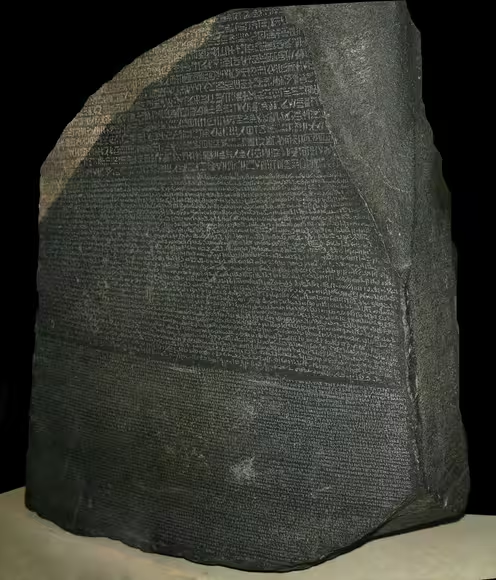
On 27 September 1822, French scholar Jean-François Champollion presented findings that transformed the study of ancient Egypt. His work on deciphering hieroglyphs, outlined in the celebrated Lettre à M. Dacier, was presented to the Académie des Inscriptions et Belles-Lettres in Paris. The announcement is widely regarded as a founding moment of modern Egyptology.
The Rosetta Stone Provides a Key
A crucial clue had emerged in 1799, when French soldiers discovered the Rosetta Stone near the Egyptian town of Rosetta, now known as Rashid. The stone carried versions of a decree issued in 196 BC, written in three scripts: Egyptian hieroglyphs, Demotic and ancient Greek.
Because scholars could read ancient Greek, the inscription offered a starting point for understanding the Egyptian texts. Yet comparing the scripts was far from straightforward. Decipherment required years of research, close observation and knowledge of languages.
More Than Pictures
One of the central challenges was understanding what hieroglyphic signs represented. Their pictorial appearance had encouraged interpretations that treated them mainly as symbols of ideas. A decisive step was recognising that signs could also represent sounds.
English scholar Thomas Young had already identified phonetic elements in the royal name Ptolemy. Champollion extended this work through comparisons of royal names and inscriptions, drawing on his deep knowledge of Coptic, a later form of the Egyptian language.
His research helped reveal that phonetic writing was not limited to foreign names. It was an essential part of the Egyptian writing system itself, which combined signs representing sounds with signs conveying meaning.
A Breakthrough, Not an Instant Translation
The announcement of September 1822 did not mean that every Egyptian inscription could suddenly be read. Champollion continued to develop his understanding, publishing a fuller explanation of the hieroglyphic system in 1824.
The Rosetta Stone was central to this achievement, but other inscriptions and earlier scholars’ contributions also mattered. Decipherment emerged from the combination of these sources and Champollion’s ability to recognise the relationships between them.
Opening Ancient Egypt’s Written Record
The breakthrough gave researchers a way to study ancient Egypt through its own surviving words. Inscriptions and manuscripts could gradually reveal far more about rulers, religious beliefs, literature and everyday life.
On 27 September 1822, the study of Egyptian monuments gained a powerful new dimension: the possibility of reading the language preserved upon them.
Other Events on This Day
- The Birth of Grazia Deledda, Sardinia’s Nobel-Winning Writer
- The Stockton and Darlington Railway Opens
Credits: 1st photo by Hans Hillewaert / Wikimedia Commons, CC BY-SA 4.0. Sources: British Museum – Eureka! Finding the key to ancient Egypt; British Museum – The Rosetta Stone; Bibliothèque nationale de France – Jean-François Champollion


