
Sep
26
26
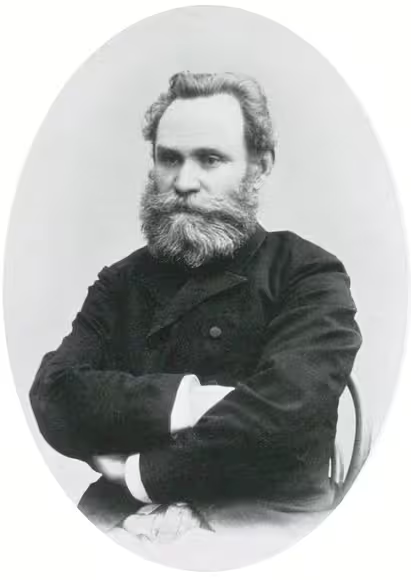
On 26 September 1849, Russian physiologist Ivan Petrovich Pavlov was born in Ryazan. His research would help explain how the body controls digestion and how animals learn to associate signals with events. Today, his name is closely connected with classical conditioning, a fundamental concept in the study of learning.
His birth was recorded as 14 September under the Julian calendar then used in Russia, corresponding to 26 September in the Gregorian calendar.
A Path into Science
The son of a priest, Pavlov initially followed a religious education before turning towards the natural sciences. He studied in Saint Petersburg and continued his training in medicine, developing a lasting interest in how living organisms function.
His research focused on processes that could be observed and measured. This approach guided his investigations into the nervous system and its role in regulating the body’s activity.
A Nobel Prize for Digestion
During the 1890s, Pavlov conducted extensive research into digestion at the Institute of Experimental Medicine in Saint Petersburg. Working with dogs, he investigated digestive secretions and the mechanisms controlling them. His methods involved surgical procedures that allowed researchers to study these processes over extended periods.
In 1904, he received the Nobel Prize in Physiology or Medicine for his work on the physiology of digestion. Although his name later became especially famous through studies of learned responses, the Nobel award specifically recognised his digestive research.
How Signals Become Meaningful
While studying digestion, Pavlov observed that dogs could begin to salivate before food reached their mouths. Signals associated with feeding could themselves bring about the response.
He investigated this systematically. When an initially neutral signal, such as a sound, repeatedly preceded food, a dog could learn the association and eventually salivate in response to the signal alone. This learned reaction became known as a conditioned reflex.
A Lasting Scientific Influence
Pavlov’s experiments helped make learning a subject of controlled laboratory investigation. Their influence extended beyond physiology into psychology, providing researchers with a way to examine how experience changes responses to the environment.
He died on 27 February 1936 in Leningrad, now Saint Petersburg. His work remains an important chapter in the history of research into digestion, behaviour and learning.
Other Events on This Day
- Britain and China Initial the Agreement on Hong Kong’s Future
- Einstein Publishes His Special Theory of Relativity
Credits: 1st photo: Unknown photographer / U.S. National Library of Medicine, via Wikimedia Commons. Public domain. Sources: NobelPrize.org – Ivan Pavlov: Biographical; American Physiological Society – The First Nobel Prize for Integrated Systems Physiology; Linda Hall Library – Ivan Pavlov


