
Sep
25
25
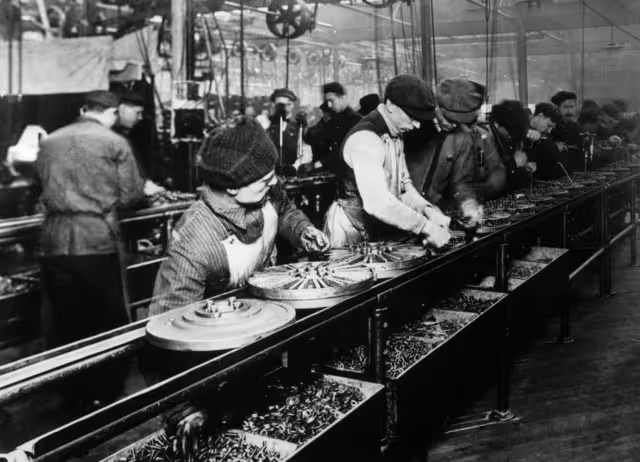
25 September 1926 is widely cited as the date Henry Ford announced the five-day, forty-hour working week. The policy became a landmark in industrial history, helping make a two-day weekend a realistic prospect for more American workers.
The change had already begun earlier that year. Ford Motor Company’s factory workers adopted the new schedule on 1 May 1926, with office employees following in August. September’s announcement belongs to the wider story of the policy’s introduction and public promotion.
From Six Days to Five
For many industrial workers, a six-day working week was still normal. Ford’s move reduced the standard schedule from forty-eight hours to forty hours across five days, giving employees more time away from the factory.
The eight-hour working day was an earlier reform. Ford had introduced it in 1914, alongside the celebrated five-dollar-a-day programme. The major change in 1926 was therefore the shorter working week.
Why Ford Supported More Leisure
Ford presented the policy as sound business practice. He believed that improved production methods could make shorter hours compatible with strong output, and he expected efficient work during the hours employees remained on the job.
He also linked leisure to consumer demand. Workers with time to travel, shop and enjoy recreation had more opportunities to use the goods that industry produced, including motor cars. In his view, mass production depended on a society able to consume its products.
An Influential Example
Ford did not invent the campaign for shorter working hours. Workers and reformers had pursued that goal long before 1926, and some businesses already operated shorter schedules. What made Ford’s decision particularly influential was the scale and prominence of his company.
The policy challenged the assumption that industrial success required six working days every week. It did not immediately establish a universal standard, but it gave the five-day week a powerful advocate.
Ford’s experiment became an important chapter in the gradual emergence of the modern weekend, bringing questions about productivity, consumption and time outside work into the centre of industrial debate.
Other Events on This Day
- TAT-1 Opens a New Era in Transatlantic Communication
- The Birth of Lu Xun, a Pioneer of Modern Chinese Literature
Credits: 1st photo: Unknown photographer / U.S. National Archives, via Wikimedia Commons. Public domain in the United States. Sources: The Henry Ford — Ford Motor Company Chronology; HISTORY — Ford Factory Workers Get 40-Hour Week; TIME — The 40-Hour Revolution


