
Sep
24
24
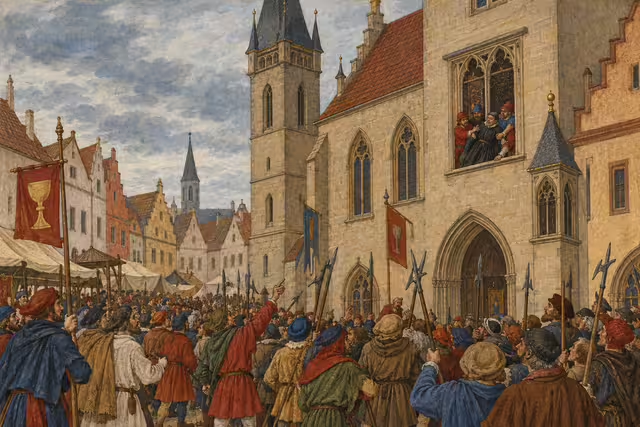
On 24 September 1483, religious and political tensions erupted into violence in Prague. Rebels seized control of the city’s town halls, throwing the Old Town burgomaster and the bodies of seven New Town councillors from their windows. The uprising became known as the Second Defenestration of Prague.
A City Divided by Faith and Power
Decades after the Hussite Wars, religious divisions continued to shape life in Bohemia. The Utraquists, heirs to the Hussite reform movement, defended the right of lay worshippers to receive both bread and wine at Communion. They feared that their religious position and political influence were under threat.
During the reign of the Catholic king Vladislaus II Jagiellon, distrust grew between rival groups in Prague. Reports of a planned crackdown against prominent Utraquists helped persuade their supporters to act first.
Violence at the Town Halls
Prague was then a group of separate municipalities, each with its own government. The revolt spread across the Old Town, New Town and Lesser Town, targeting the councils that governed them.
At the Old Town Hall, the burgomaster was thrown from a window. In the New Town, seven councillors were killed and their bodies cast out of the town hall. The distinction is significant: not all those defenestrated were alive when they were thrown.
The upheaval extended beyond the council chambers. Religious houses were attacked, and the Jewish quarter also suffered violence. What began as a struggle over municipal authority became a wider uprising.
From Revolt to Religious Settlement
The coup strengthened Utraquist control in Prague and helped prevent a reversal of the religious changes established after the Hussite movement.
The confrontation was followed by negotiations. In 1485, the Religious Peace of Kutná Hora established a framework for coexistence between Catholics and Utraquists in Bohemia. It was a significant settlement between the two traditions, although it did not amount to unrestricted religious freedom.
The Less Familiar Defenestration
The events of 1483 stand between Prague’s better-known defenestrations of 1419 and 1618. Numbering varies: English-language accounts often call the 1618 incident the Second Defenestration, omitting the uprising of 1483 from the sequence.
Yet the violence of September 1483 was an important turning point in its own right, reshaping Prague’s government and contributing to the political conditions for a negotiated religious peace.
Other Events on This Day
Credits: 1st photo: Artistic reconstruction, not an original period image or an exact depiction of the building. Sources: Encyclopedia of Prague 2 — Defenestration at the New Town Hall; Defenestrations of Prague — The 1483 defenestration


