Sep
23

A Storm Brings the First Europeans to Japan

A Storm Brings the First Europeans to Japan

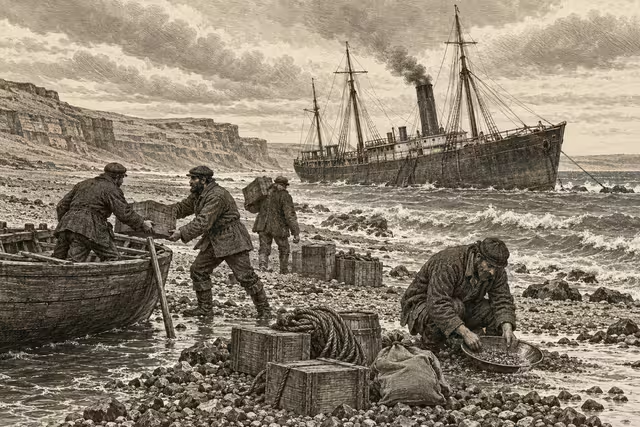
On September 23, 1543, Portuguese traders reached the Japanese island of Tanegashima after their ship was driven off course. Their unexpected arrival marked the first well-documented direct contact between Europeans and Japan — and began a new chapter in the country's history.

The encounter would influence Japanese warfare, trade, technology, religion, and relations with the outside world for generations.

An Accidental Arrival

The Portuguese did not set out on a carefully planned expedition to discover Japan.

They were travelling aboard a Chinese junk when bad weather pushed the vessel toward Tanegashima, a small island south of Kyushu.

Among the Portuguese merchants associated with the landing were António da Mota and Francisco Zeimoto.

Later accounts sometimes mention other names, including António Peixoto and the famous traveller Fernão Mendes Pinto, but historians are less certain about their presence during the first encounter.

A Date That Can Be Misleading

Traditional Japanese records date the event to the 25th day of the eighth month of the 12th year of the Tenbun era.

This is sometimes incorrectly interpreted as August 25, 1543.

Japan, however, was using a lunisolar calendar at the time. Converted into the modern calendar, the date corresponds to approximately September 23, 1543.

The Weapons That Caught Japan's Attention

The Portuguese carried something that immediately attracted the attention of the local Japanese authorities: matchlock arquebuses.

Firearms were not entirely unknown in East Asia, but the Portuguese weapons represented a technology that Japanese craftsmen could study, reproduce, and improve.

The local lord, Tanegashima Tokitaka, obtained examples of the weapons and ordered his craftsmen to learn how they worked.

Japan Learns to Build Its Own Guns

Japanese metalworkers quickly began producing their own versions of the matchlock gun.

Within a relatively short time, firearms were being manufactured in significant numbers and spreading through a country already divided by the conflicts of the Sengoku period.

The weapon became so closely associated with the island where the Portuguese had landed that matchlock guns were commonly known in Japan as tanegashima.

A New Weapon Changes Warfare

Firearms gradually became an important part of Japanese military strategy.

Japanese commanders learned to deploy large groups of arquebusiers, combining disciplined volleys of gunfire with traditional infantry and cavalry tactics.

By the second half of the 16th century, guns were playing an important role in the struggles that eventually led to the political unification of Japan.

The Portuguese arrival therefore had consequences far beyond a single encounter between merchants and islanders.

The Beginning of Nanban Trade

The landing at Tanegashima also opened the way for a wider period of contact between Japan and European traders.

Portuguese ships began visiting Japanese ports regularly, participating in what became known as the Nanban trade.

The word “Nanban” literally referred to “southern barbarians,” a term Japanese observers used for Europeans arriving from the south through Asian trade routes.

Merchants brought goods, technologies, textiles, clocks, glassware, weapons, and new foods. In return, Japan exported products including silver and luxury goods.

New Ideas Arrive as Well

Trade was soon followed by religion and cultural exchange.

In 1549, the Jesuit missionary Francis Xavier arrived in Japan and began preaching Christianity.

Christian communities later developed in several parts of the country, especially in Kyushu.

European influences also appeared in art, clothing, cuisine, shipbuilding, and language.

A Century of Contact

Relations between Japan and Europeans would eventually become more complicated.

Japanese rulers grew increasingly concerned about foreign religious influence and the political ambitions of European powers.

During the 17th century, Christianity was heavily suppressed and Japan introduced strict controls on foreign contact.

But the changes that had begun in 1543 could not simply be erased.

A Chance Encounter With Lasting Consequences

The arrival of António da Mota, Francisco Zeimoto, and their companions was not a carefully planned diplomatic mission.

It was the result of weather, navigation, trade, and chance.

Yet their landing on Tanegashima in September 1543 became one of the most important encounters in the history of relations between Japan and Europe.

A storm had carried a group of travellers to an unfamiliar island — and helped connect two worlds that had previously known almost nothing about one another.