
Sep
22
22
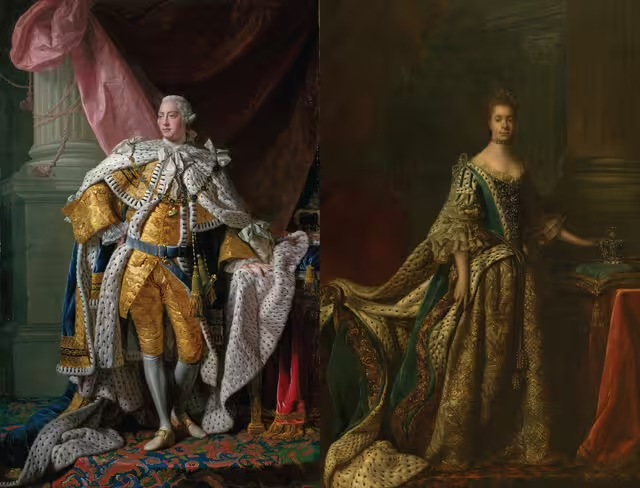
On September 22, 1761, King George III and his young wife Queen Charlotte were crowned together at Westminster Abbey in London.
The ceremony came only fourteen days after their wedding.
Charlotte had arrived in Britain from Germany on September 8 and met George for the first time that same day. Within hours, they were married at the Chapel Royal in St James's Palace.
Two weeks later, the 23-year-old king and his 17-year-old queen became the central figures in one of the grandest public ceremonies of the Georgian age.
The coronation lasted for hours.
The royal procession moved from Westminster Hall to the Abbey through streets crowded with spectators, George was anointed and crowned according to ancient tradition, Charlotte underwent a separate but simpler coronation ceremony, and the celebrations concluded with an enormous banquet in Westminster Hall.
It marked the ceremonial beginning of a reign that would last almost sixty years and span some of the most consequential events of the 18th and early 19th centuries.
A Young King
George III had become king almost a year earlier.
His grandfather, George II, died on October 25, 1760, and the Crown immediately passed to the 22-year-old George.
George's father, Frederick, Prince of Wales, had died in 1751, making the young prince heir to his grandfather.
George III was the third monarch of the House of Hanover to rule Britain.
But he differed from his two predecessors in an important way.
George I had been born in Hanover and George II in Germany.
George III had been born in London in 1738.
He was the first Hanoverian king born in Britain and the first whose native language was English.
A King During a Global War
George inherited the throne while Britain was fighting the Seven Years' War.
The conflict involved major European powers and extended across Europe, North America, the Caribbean, Africa and Asia.
Britain had achieved important military victories, but the war was enormously expensive.
The young king therefore began his reign at a moment when Britain was expanding its international power while accumulating substantial financial obligations.
Those pressures would influence British politics long after the coronation celebrations ended.
Westminster Abbey
Westminster Abbey had been the traditional setting for English coronations for centuries.
William the Conqueror had been crowned there in 1066, and generations of monarchs followed.
The coronation of George III therefore linked the young Hanoverian king with a ceremonial tradition stretching back hundreds of years.
The Abbey was transformed for the occasion.
Temporary galleries were constructed to accommodate invited spectators, while elaborate seating provided places for the political, religious and aristocratic elite.
Admission tickets themselves became decorative souvenirs.
A Kingdom Larger Than Britain
George III's formal title included kingship of both Great Britain and Ireland.
At the time of his coronation, the modern United Kingdom did not yet exist under that name.
England and Scotland had been united politically as Great Britain since 1707.
Ireland remained a separate kingdom sharing the same monarch.
The Kingdom of Great Britain and the Kingdom of Ireland would not formally unite until 1801, during George's reign.
The political geography surrounding the Crown therefore changed substantially between his coronation and death.
A Reign That Would Span Nearly Sixty Years
Few people attending the coronation could have anticipated how long George III would remain king.
His reign lasted from 1760 until 1820.
During those decades, Britain experienced the conclusion of the Seven Years' War, the conflict that led to American independence, the French Revolution and the long wars against Revolutionary and Napoleonic France.
Britain's overseas empire changed dramatically, while industrialization accelerated at home.
The political institutions operating around the monarchy also continued to develop.
The young king who walked into Westminster Abbey in 1761 therefore remained on the throne through a period of profound transformation.
Charlotte's Long Role as Queen
Charlotte also occupied her position for decades.
She remained queen consort until her death in 1818.
Her public reputation became associated not only with motherhood and court life but with cultural patronage.
She supported musicians and artists, developed a strong interest in botany and maintained connections with institutions associated with science and the arts.
Her name survives in numerous places and institutions created or renamed during the period of British expansion.
Other Events on This Day
Credits: 1st photo: Public Domain, via Wikimedia Commons / Royal Collection.


