
Sep
22
22
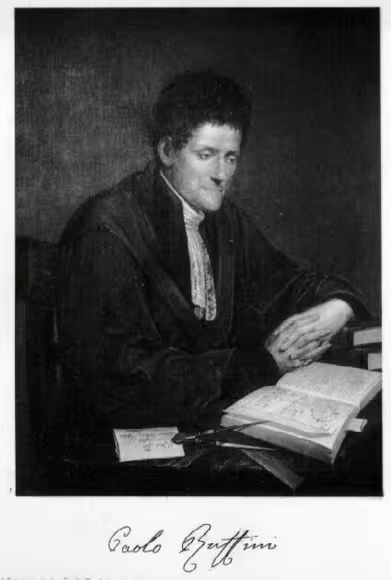
On 22 September 1765, Italian mathematician, philosopher and physician Paolo Ruffini was born in Valentano, then part of the Papal States. His work would challenge a long-standing ambition in mathematics: finding a universal formula for solving equations of the fifth degree.
A Life Across Disciplines
Ruffini entered the University of Modena in 1783, studying mathematics and medicine alongside philosophy and literature. These interests shaped a career that combined academic research, teaching and the care of patients.
Modena became the centre of his professional life. He taught mathematics there and later served as the university’s rector, taking up that position in 1814. His philosophical writings also explored questions beyond mathematics, including criticism of ideas advanced by the French scholar Pierre-Simon Laplace.
The Challenge of the Fifth Degree
For centuries, mathematicians had searched for formulas to solve polynomial equations. Methods were known for equations of the second, third and fourth degrees, but the general fifth-degree equation, known as the quintic, resisted their efforts.
In 1799, Ruffini published an argument that no general formula using only arithmetic operations and root extractions could solve every quintic equation. Instead of producing the long-sought formula, he sought to establish why it could not exist.
His proof contained a gap and did not gain widespread acceptance. Nevertheless, it marked an important step towards the result now called the Abel–Ruffini theorem, subsequently established by Norwegian mathematician Niels Henrik Abel.
The distinction matters: particular quintic equations can be solved using radicals. What is impossible is a single formula of that kind that works for all of them.
A Name That Lives On
Ruffini is also remembered for Ruffini’s rule, a compact procedure for dividing a polynomial by a linear expression. This practical contribution has kept his name familiar to generations of mathematics students.
Alongside his scholarship, he continued practising medicine. During a typhus epidemic in 1817, he became ill while treating patients. He died in Modena on 10 May 1822.
His legacy combines a useful classroom method with a profound mathematical insight: progress can come from understanding the limits of what a method can achieve.
Other Events on This Day
- Brighton’s Duke of York’s Picture House Opens
- George III and Queen Charlotte Are Crowned at Westminster Abbey
Credits: 1st photo: Unknown artist / Wikimedia Commons. Public domain. Sources: University of St Andrews and Università Bocconi.


