
Sep
17
17
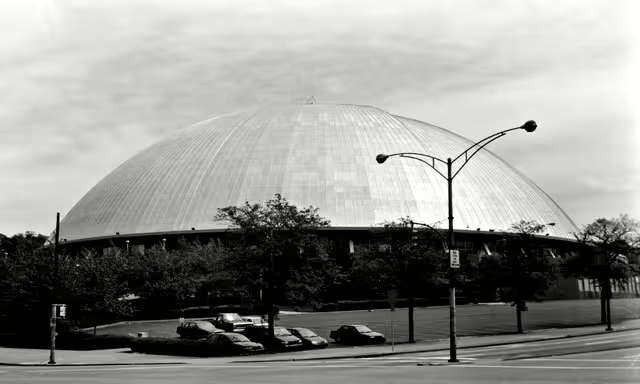
On September 17, 1961, Pittsburgh dedicated one of the most unusual buildings ever constructed for entertainment and sports: the Civic Arena.
Its enormous stainless-steel dome contained a feature never before successfully incorporated into a major indoor sports venue on such a scale.
The roof could open.
Six huge sections of the dome could slide beneath two stationary sections, exposing much of the arena to the sky in only a few minutes.
The Civic Arena became the world's first major indoor sports and entertainment venue with a retractable roof, anticipating a concept that would decades later become familiar at stadiums around the world.
A New Kind of Arena
The Civic Arena did not begin as a plan for professional hockey.
It was originally conceived primarily as a home for the Pittsburgh Civic Light Opera, which had been staging summer performances outdoors at Pitt Stadium.
Outdoor theatre presented an obvious problem.
Rain could interrupt a performance, while a permanent conventional roof would eliminate the experience of performing beneath the summer sky.
The solution was extraordinarily ambitious: build an enormous covered auditorium whose roof could be opened when the weather was good and closed when it was not.
It would offer both an indoor theatre and an outdoor performance space within the same building.
Edgar J. Kaufmann and an Ambitious Idea
One of the driving forces behind the project was Pittsburgh businessman and philanthropist Edgar J. Kaufmann, whose family owned the famous Kaufmann's department store.
Kaufmann had already demonstrated an interest in ambitious modern architecture.
His family retreat outside Pittsburgh was Fallingwater, the celebrated house designed by architect Frank Lloyd Wright.
For Pittsburgh's new cultural venue, the ambition was similarly bold.
Rather than constructing an ordinary auditorium, planners wanted a building that could become an architectural symbol of a city attempting to reinvent itself after decades of industrial pollution and economic change.
The Pittsburgh Renaissance
The Civic Arena emerged during Pittsburgh's postwar redevelopment program, frequently called the Pittsburgh Renaissance.
During the first half of the 20th century, Pittsburgh had become internationally associated with steel production, heavy industry and severe air pollution.
After the Second World War, business and political leaders launched projects intended to clean the city's air, redevelop central districts and replace older industrial and residential areas with modern offices, parks, highways and cultural facilities.
The Civic Arena was intended to become one of the most visible symbols of that transformation.
But the redevelopment also came at an enormous human cost.
The Lower Hill District
The site selected for the arena was in Pittsburgh's Lower Hill District.
The Hill District had developed into one of America's important African American cultural communities and was particularly famous for its jazz clubs, restaurants and nightlife.
Musicians including some of the greatest names in American jazz performed there, and the neighborhood became known as a major center of Black cultural life.
City redevelopment authorities, however, classified large parts of the Lower Hill as deteriorated and targeted approximately 95 acres for urban renewal.
Beginning in the mid-1950s, hundreds of buildings were demolished.
More than 8,000 residents and hundreds of businesses were displaced by the wider redevelopment project.
Many of those residents were African American, and later assessments of the project have emphasized the severe disruption it caused to the social and economic fabric of the Hill District.
A Neighborhood Replaced by a Vision
The original redevelopment plan envisioned much more than a single arena.
Hotels, apartments, offices and cultural institutions were supposed to create an entirely new district between downtown Pittsburgh and the remaining Hill neighborhoods.
Much of that vision was never completed.
The Civic Arena became the most prominent structure on a landscape increasingly dominated by parking lots and cleared land.
The building was therefore two things at once.
It was a remarkable engineering achievement celebrated around the world, but it was also connected to an urban renewal program that displaced thousands of people.
Both stories became part of its historical legacy.
Building the Giant Dome
Construction began in 1958.
The architectural firm Mitchell & Ritchey worked on the project, with major structural engineering contributions from Ammann & Whitney and other specialists.
The greatest challenge was the roof.
The dome measured approximately 415 feet, or 126 meters, in diameter.
It covered roughly 170,000 square feet and incorporated thousands of tons of steel.
Yet engineers could not simply support the structure with columns inside the arena.
Interior columns would obstruct views of the stage and playing surface.
The solution was an enormous external support structure.
A 260-Foot Cantilever
The roof was supported by a massive 260-foot cantilevered structure extending outside the building.
This allowed the interior to remain largely free of structural columns.
Audiences could therefore see the stage or playing surface without having their view interrupted by large supports.
Engineering an enormous movable dome without conventional internal columns was a remarkable achievement for the period.
But the most extraordinary feature remained the mechanism that allowed the roof itself to disappear.
Eight Pieces of Steel
The giant dome was divided into eight sections.
Two remained stationary.
The other six sections could move.
When the roof opened, the movable sections traveled along circular tracks and nested beneath the stationary portions of the dome.
Large powered wheel assemblies carried the enormous sections around the perimeter of the building.
Despite the tremendous weight involved, the entire roof could be opened in approximately two and a half minutes.
A building that appeared to be a permanently enclosed steel dome could therefore transform itself before an audience's eyes.
September 17, 1961
On September 17, 1961, thousands of people gathered for the public dedication of Pittsburgh's extraordinary new arena.
A band performed during the ceremonies as politicians, officials and spectators watched the enormous roof demonstrate what it could do.
The panels began moving.
Slowly, the steel dome opened and the Pittsburgh skyline appeared above the audience.
For people accustomed to thinking of roofs as permanent structures, the sight was extraordinary.
A building weighing thousands of tons seemed to be changing shape around them.
The First Performance
The arena's first major public entertainment performance followed the dedication.
On September 18, the Ice Capades appeared before thousands of spectators.
The new venue quickly began hosting an enormous variety of events.
There were ice shows, concerts, political gatherings, basketball games, wrestling matches, boxing events and exhibitions.
Eventually, however, one sport would become more closely associated with the building than any other.
That sport was ice hockey.
The Pittsburgh Penguins Arrive
In 1967, the National Hockey League expanded from six teams to twelve.
One of the new franchises was the Pittsburgh Penguins.
The Civic Arena became their home.
The futuristic silver dome and Pittsburgh's new NHL team soon became inseparable in the city's identity.
Over time, hockey transformed the building from an ambitious cultural auditorium into one of America's most recognizable sports arenas.
Generations of Penguins players and supporters would come to regard the arena as home.
The Igloo
The Civic Arena's rounded stainless-steel exterior quickly inspired a nickname.
People began calling it the Igloo.
The name became particularly appropriate after the Penguins made the building famous as a hockey venue.
From above, the shining segmented dome looked unlike almost any other major arena.
Its appearance became one of the most recognizable elements of Pittsburgh's skyline.
A Roof That Rarely Opened
Ironically, the feature that made Civic Arena revolutionary was not used as frequently as its designers originally imagined.
Operating the enormous roof required favorable weather and considerable preparation.
Rain, wind and the equipment suspended inside the building could complicate the procedure.
Maintenance also became increasingly difficult as the structure aged.
The Civic Light Opera itself eventually left the arena, partly because the enormous building was not ideal acoustically for theatrical productions.
The roof nevertheless continued to be opened on special occasions.
Its existence remained the arena's defining engineering feature even when it was closed.
Rock Music Under a Moving Dome
As popular music became increasingly dependent on large concert venues, the Civic Arena attracted many of the world's most famous performers.
The building hosted generations of major artists and bands as touring concerts became larger and more technologically ambitious.
Its combination of enormous interior space and distinctive architecture made it an important stop for touring performers.
The arena therefore became part of Pittsburgh's cultural history far beyond professional sports.
A Stage for Politics and Public Life
The Civic Arena also served as a gathering place for major public and political events.
Presidential candidates and national leaders appeared there, while religious gatherings, conventions and community events filled the building at different moments.
Its enormous capacity made it one of Pittsburgh's most important public meeting spaces.
For almost half a century, countless residents entered through its doors for events ranging from hockey games to graduations.
Mario Lemieux and a New Era
By the 1980s, the Pittsburgh Penguins were struggling financially and competitively.
That began to change dramatically after the team selected Canadian superstar Mario Lemieux with the first overall pick in the 1984 NHL draft.
Lemieux became one of hockey's greatest players and helped transform the fortunes of the franchise.
The Civic Arena became the stage for the Penguins' rise into one of the NHL's leading teams.
With stars including Lemieux, Jaromír Jágr, Ron Francis and others, Pittsburgh won consecutive Stanley Cup championships in 1991 and 1992.
The building that had been designed for light opera was now known internationally as the home of championship hockey.
From Civic Arena to Mellon Arena
For most of its history, the building was simply known as the Civic Arena.
In 1999, a naming-rights agreement changed its official name to Mellon Arena.
Many Pittsburgh residents continued to call it the Civic Arena or simply the Igloo.
By then, however, the structure was showing its age.
Professional sports arenas had changed dramatically since 1961.
New buildings contained larger concourses, luxury suites, modern concessions, improved accessibility and extensive commercial facilities that the older arena had never been designed to accommodate.
The Roof Becomes History
The retractable roof itself also became increasingly difficult to operate.
Opening six enormous steel panels required machinery that had been designed decades earlier.
Repairs were expensive and the practical reasons for opening the roof had largely disappeared.
Full operation of the mechanism eventually ceased, and in the building's final years the dome remained closed.
Nevertheless, the engineering principle demonstrated in Pittsburgh had spread around the world.
A Concept Ahead of Its Time
When Civic Arena opened, retractable stadium roofs were an architectural curiosity.
Decades later they became a major feature of modern stadium design.
Facilities in cities with extreme heat, rain, snow or unpredictable weather could offer outdoor conditions when appropriate and a protected interior when necessary.
Modern retractable roofs use completely different materials, computer controls and engineering systems, but they address essentially the same problem that Pittsburgh engineers confronted in the 1950s.
How can a building provide the advantages of both an open-air stadium and an enclosed arena?
Civic Arena demonstrated one of the earliest large-scale answers.
A New Home for the Penguins
By the beginning of the 21st century, the Penguins and local authorities were discussing construction of a modern replacement.
A new arena was eventually built across the street.
The Penguins played their final season at the old building in 2009–2010.
After nearly five decades, the Civic Arena closed.
The team's new home opened for the 2010–2011 NHL season.
Preserve It or Demolish It?
The closing of Civic Arena created a difficult question.
Should the historic building be preserved?
Supporters of preservation argued that its retractable dome made it an important example of mid-20th-century engineering and architecture.
Others argued that preserving and converting such an enormous specialized structure would be prohibitively expensive and would interfere with plans to reconnect the Lower Hill District with surrounding neighborhoods.
The debate was complicated by the building's relationship with the history of urban renewal.
For some people, the arena was a beloved Pittsburgh landmark.
For others, it remained a symbol of the destruction of the Lower Hill.
The Igloo Comes Down
Ultimately, the decision was made to demolish the Civic Arena.
Demolition began in 2011.
The process took place gradually as the enormous steel structure was carefully dismantled.
On March 31, 2012, the final sections of the famous roof came down.
The world's pioneering retractable-roof arena had disappeared from Pittsburgh's skyline.
Its engineering legacy, however, remained.
Rebuilding the Lower Hill
The demolition also reopened a much older discussion about what should happen to the land beneath the arena.
Modern redevelopment plans have attempted to reconnect the Lower Hill with surrounding parts of the city and restore portions of the street network that existed before the urban renewal project.
The history of the neighborhood has become an important part of those discussions.
The story of Civic Arena therefore cannot be separated from the community that existed before it.
Its construction produced an engineering landmark while simultaneously contributing to one of Pittsburgh's most disruptive episodes of urban redevelopment.
A Building of Contradictions
Few buildings represent the ambitions and contradictions of postwar American urban planning as clearly as Civic Arena.
Architecturally, it was extraordinarily ambitious.
Its immense unsupported dome and moving roof pushed structural engineering into new territory.
Culturally, it became a home for opera, music, entertainment and eventually championship hockey.
But creating it required the destruction of a large part of an established urban neighborhood and displaced thousands of people.
The same building could therefore represent technological optimism to one generation and the failures of urban renewal to another.
The Legacy of the Retractable Roof
Today, retractable roofs can be found on major sports facilities around the world.
Some slide horizontally. Others fold, rotate or separate into multiple panels.
Modern lightweight materials and computer-controlled motors allow enormous roofs to move in ways that would have seemed extraordinary in 1961.
Yet Pittsburgh's Civic Arena demonstrated the basic concept decades earlier.
A stadium or arena did not necessarily have to choose permanently between indoors and outdoors.
Its architecture itself could move.
September 17, 1961
When the Civic Arena was dedicated in Pittsburgh on September 17, 1961, thousands of spectators watched its enormous stainless-steel roof slide apart above them.
Six sections of a gigantic dome moved aside, revealing the sky and the city beyond.
It was a spectacular demonstration of what architects and engineers believed the buildings of the future might become.
The arena would eventually host professional hockey, championship teams, concerts and countless public events before disappearing from the Pittsburgh skyline more than half a century later.
Its history also became inseparable from the displacement and urban renewal that transformed the Lower Hill District.
But as an engineering achievement, the idea introduced so dramatically that September day endured.
A roof no longer had to be permanent. Even one weighing thousands of tons could move.
Other Events on This Day
- Antonie van Leeuwenhoek Describes Bacteria Living on Human Teeth
- The First Linux Kernel Is Released Online
Credits: 1st photo by Cbaile19. CC0 1.0, via Wikimedia Commons.


