
Oct
8
8
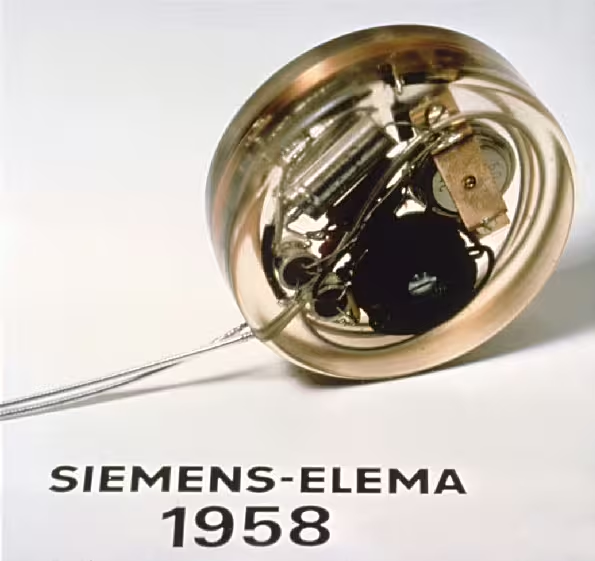
On October 8, 1958, Swedish surgeon Åke Senning implanted the world’s first fully implantable cardiac pacemaker in a human patient at Karolinska Hospital in Stockholm. Developed by physician and inventor Rune Elmqvist in collaboration with Senning, the experimental device marked an important turning point in the treatment of dangerous heart rhythm disorders.
A Patient Running Out of Time
The patient, 43-year-old Arne Larsson, suffered from complete heart block, a condition in which electrical signals fail to pass normally from the heart’s upper chambers to its lower chambers. He repeatedly lost consciousness and required frequent resuscitation. His situation had become desperate.
His wife, Else-Marie, learned that Senning and Elmqvist were developing an implantable pacemaker and urged them to help. The device was still experimental, but her persistence helped bring their work into the operating room.
A Pacemaker Inside the Body
Earlier pacemakers relied on equipment outside the patient’s body. Elmqvist’s design placed the electronic components and rechargeable batteries together in a compact unit protected by resin. Its batteries could be recharged by transferring energy through the skin.
During the operation, Senning placed the device in Larsson’s abdominal wall and attached two electrodes to the heart muscle. The pacemaker delivered electrical impulses intended to maintain a dependable heartbeat.
A Breakthrough with a Difficult Beginning
The first device stopped working after only a few hours and had to be replaced. This was a pioneering operation with fragile experimental technology, and further improvements were essential.
Nevertheless, the procedure established that a complete pacing system could be implanted inside a person. It opened a path toward devices that would become more reliable and better suited to long-term use.
The Patient Who Lived to See the Progress
Larsson’s story continued for another 43 years. Over his lifetime, he received a succession of replacement pacemakers as the technology developed. He returned to an active life and became an advocate for continued improvements in cardiac pacing.
He died in 2001 at the age of 86, having outlived both Elmqvist and Senning. His remarkable journey gave a human face to the achievement of October 8, 1958: a collaboration between medicine and engineering that helped transform the possibilities of heart care.
Other Events on This Day
- Don Larsen Pitches the Only Perfect Game in World Series History
- Heinrich Schütz, a Pioneering Voice of German Baroque Music, Is Born
Credits: 1st photo: Professor Marko Turina, University Hospital, Zurich, via Wikimedia Commons. Licensed under CC BY 3.0. Sources: Siemens Healthineers MedMuseum — A Lifesaver in a Plastic Cup; A Brief History of Cardiac Pacing.; IEEE Spectrum — Rune Elmqvist: Inkjet Printers, Implantable Pacemakers.


