
Oct
7
7
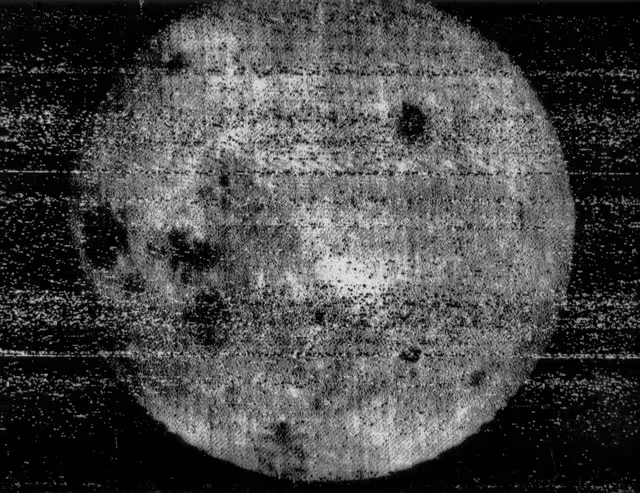
On October 7, 1959, the Soviet spacecraft Luna 3 took the first photographs of the Moon’s far side. Grainy and indistinct though they were, these images revealed a landscape that had remained hidden throughout human history. For the first time, a spacecraft had carried a camera beyond the familiar lunar face and looked back.
Why the Far Side Was Hidden
The Moon rotates once on its axis in approximately the same time that it takes to orbit Earth. This synchronised motion keeps nearly the same hemisphere facing us, leaving most of the other hemisphere beyond the reach of Earth-based observers.
The far side is sometimes called the “dark side”, but it receives sunlight just as the near side does. Its mystery came from its position, rather than a permanent absence of light.
A Camera Beyond the Moon
Launched on October 4, 1959, Luna 3 followed a trajectory that carried it past the Moon and around its far side. On October 7, the spacecraft began photographing the sunlit terrain.
During a session lasting roughly 40 minutes, its cameras took 29 photographs, together covering about 70 percent of the far side. The mission offered a first survey of an enormous region that no telescope on Earth could directly examine.
A Photographic Laboratory in Space
Luna 3 worked long before digital cameras became standard spacecraft equipment. It recorded its pictures on photographic film, which was automatically developed aboard the probe.
The developed images were then scanned and converted into signals for radio transmission to Earth. This remarkable process combined a camera, a miniature film-processing laboratory and a communications system inside a spacecraft travelling far beyond direct human reach.
A Surprisingly Different Landscape
Despite their limited quality, the photographs revealed a striking contrast. The far side had far fewer of the broad, dark plains known as maria that give the Moon’s familiar face its distinctive appearance. These plains are ancient expanses of cooled lava.
Later missions would map the far side in much greater detail, revealing its densely cratered terrain. Yet Luna 3 provided the essential first glimpse. Its photographs showed how robotic exploration could extend human vision beyond the limits of observation from Earth, opening a new chapter in the study of our nearest celestial neighbour.
Other Events on This Day
- Niels Bohr Is Born, the Danish Physicist Who Transformed Our Understanding of the Atom
- Women Become Full Members of Oxford University, Opening the Way to Degrees
Credits: 1st photo: Image: Luna 3 / OKB-1, via Wikimedia Commons. Public domain. Sources: NASA – First Close-up of the Far Side of Moon; NASA – 60 Years Ago: Luna 2 Makes Impact in Moon Race; NASA – Lunar Far Side: From Luna 3 to LRO


