
Oct
7
7
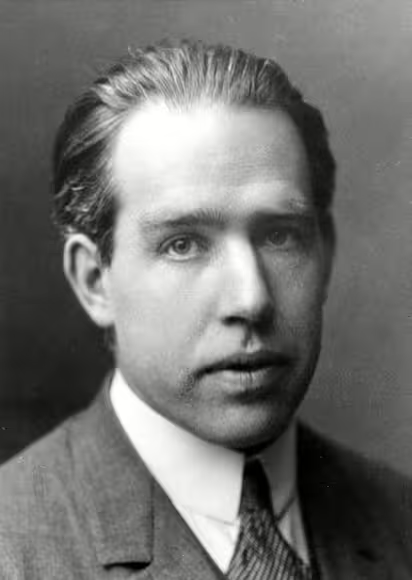
On October 7, 1885, Niels Henrik David Bohr was born in Copenhagen, Denmark. His work would help explain the structure of atoms and make him a central figure in the development of quantum physics. In 1922, he received the Nobel Prize in Physics for his investigations into atomic structure and the radiation emitted by atoms.
A New Way to Understand the Atom
Bohr studied at the University of Copenhagen, completing his doctorate in 1911. He later worked with Ernest Rutherford in Manchester, where research into the atomic nucleus was changing established ideas about matter.
In 1913, Bohr proposed an atomic model that combined Rutherford’s nuclear atom with ideas from quantum theory. In this model, electrons could occupy only certain allowed energy states. They could absorb or emit radiation when moving between those states.
The model helped explain the distinctive lines in the spectrum of hydrogen: the specific wavelengths of light that hydrogen atoms emit. Although later quantum mechanics replaced its picture of electrons following fixed orbits, Bohr’s model was a decisive step towards understanding atomic behaviour.
Copenhagen Becomes a Centre of Discovery
In 1921, an institute for theoretical physics opened at the University of Copenhagen under Bohr’s leadership. It became an international meeting place where researchers could test ideas through discussion and connect theoretical questions with experimental results.
Bohr’s influence extended beyond his own discoveries. The institute encouraged exchanges between scientists who were developing the new quantum mechanics, helping Copenhagen become one of the field’s most important centres.
Thinking Beyond Everyday Experience
In 1927, Bohr introduced his principle of complementarity. It addressed how quantum phenomena can reveal different aspects depending on the experimental arrangement. Light, for example, can display wave-like or particle-like behaviour.
For Bohr, these descriptions had to be considered together, even though they could not be applied in the same way within a single experiment. His discussions with Albert Einstein became famous debates about the meaning and limits of physical knowledge.
A Lasting Scientific Legacy
Bohr died in Copenhagen on November 18, 1962. His legacy includes both a pioneering model of the atom and an approach to science built around careful questioning and open discussion. His work helped establish the foundations of modern atomic physics and reshaped how scientists describe the microscopic world.
Other Events on This Day
- Luna 3 Photographs the Moon’s Far Side for the First Time
- Women Become Full Members of Oxford University, Opening the Way to Degrees
Credits: 1st photo: AB Lagrelius & Westphal / Nobel Foundation, via Wikimedia Commons. Public domain. Sources: NobelPrize.org – Niels Bohr: Facts; University of Manchester – Nobel Prize Winners; Niels Bohr Institute – The Establishment of an Institute; Niels Bohr Institute – The Copenhagen Interpretation


