
Oct
8
8
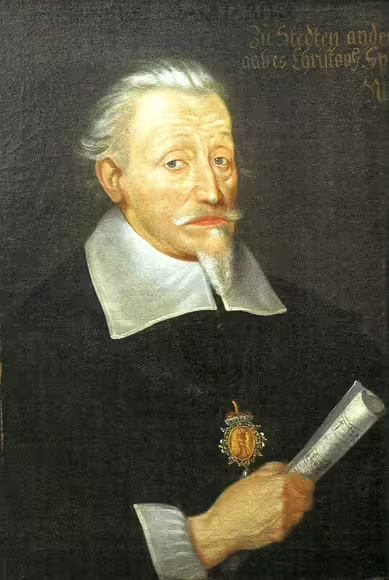
On October 8, 1585, Heinrich Schütz was born in Köstritz, now Bad Köstritz, Germany. A composer, organist, and musical director, he became one of the leading figures of the early Baroque era. His work brought Italian musical ideas into German sacred music, combining expressive writing with close attention to the meaning of words.
A Young Singer’s Opportunity
Schütz grew up in Weißenfels, where his father ran an inn. His singing attracted the attention of Landgrave Moritz of Hesse-Kassel, who offered him an education at his court. The young musician became a choirboy in Kassel, receiving the training that would shape his future.
He later studied law in Marburg, but music became his lifelong profession. With the landgrave’s support, he travelled to Venice in 1609 to study with Giovanni Gabrieli, one of the city’s foremost composers.
Lessons from Venice
Venice introduced Schütz to a rich musical world in which contrasting groups of singers and instruments could create striking effects. Gabrieli’s approach to writing for several choirs made a lasting impression on his student.
Schütz’s first published collection, a book of Italian madrigals, appeared in 1611. Returning to German-speaking lands, he developed a musical language that combined his Italian experience with the expressive possibilities of German texts.
A Long Career in Dresden
In 1617, Schütz became court music director in Dresden, beginning an association that lasted for more than fifty years. His responsibilities included providing music for worship and ceremonial occasions at the Saxon court.
The Thirty Years’ War disrupted musical life and reduced the resources available to performers. Schütz responded with works suited to smaller ensembles, including his Kleine geistliche Konzerte. He also worked in Denmark, directing music for royal celebrations in Copenhagen.
Music That Gave Words Their Full Weight
More than 500 of Schütz’s compositions survive, most of them sacred vocal works. Collections such as Psalmen Davids, Musikalische Exequien, and Geistliche Chormusik reveal the breadth of his achievement.
He continued composing into old age, producing Passion settings and his Christmas narrative. Schütz died in Dresden on November 6, 1672, aged 87. His legacy rests on music that gives the human voice extraordinary power to communicate sorrow, hope, devotion, and joy.
Other Events on This Day
- Don Larsen Pitches the Only Perfect Game in World Series History
- The First Fully Implantable Pacemaker Opens a New Chapter in Heart Care
Credits: 1st photo: Christoph Spätner, c. 1660 / Museum of Musical Instruments, Leipzig University, via Wikimedia Commons. Public domain. Sources: Heinrich-Schütz-Haus Weißenfels — Life and Work; Heinrich Schütz Musikfest — Biography


