
Oct
4
4
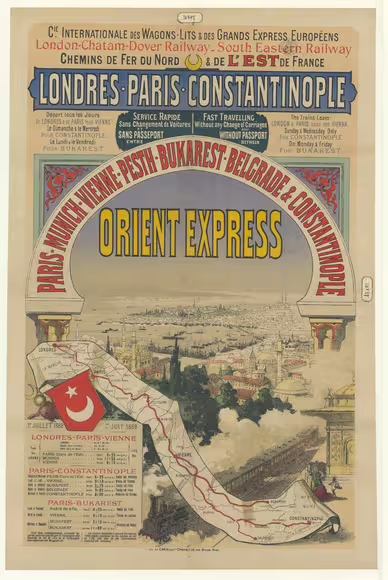
On 4 October 1883, the train that would become famous as the Orient Express departed Paris on its official inaugural journey towards Constantinople, now Istanbul. The occasion celebrated a new vision of international travel: crossing Europe in sleeping cars, dining on board and enjoying comforts rarely associated with long journeys.
A New Standard of Railway Travel
The project was closely associated with Belgian entrepreneur Georges Nagelmackers and his Compagnie Internationale des Wagons-Lits. Inspired by American sleeping cars, he developed a European service that combined overnight travel with carefully arranged accommodation and dining.
Known initially as the Express d’Orient, the service had already begun running on 5 June 1883. The October departure was its ceremonial inauguration, attended by invited guests and representatives of the press, government and railway companies.
A Journey by Rail and Water
The original route passed through cities including Munich, Vienna, Budapest and Bucharest before reaching Giurgiu in Romania. Here, the railway portion aboard the Express d’Orient came to an end.
Passengers crossed the Danube by ferry to Ruse in Bulgaria, continued by another train to the Black Sea port of Varna, and then boarded a steamship for Constantinople. The destination gave the journey its appeal, even though several connections were still required to reach it.
Comfort Across Borders
The train’s attraction extended beyond its destination. Sleeping accommodation and a dining car allowed wealthy passengers to make a lengthy journey with greater ease. International railway cooperation helped turn separate national networks into a coordinated travel experience.
The service made the journey itself part of the pleasure. Meals, conversation and changing landscapes became elements of an experience that would give the Orient Express its enduring association with elegance and adventure.
The Making of a Legend
Direct railway service to Constantinople followed in 1889. Over subsequent decades, the Orient Express became a familiar name far beyond the people who could afford to travel aboard it.
Literature and cinema strengthened that reputation, most famously through Agatha Christie’s Murder on the Orient Express. The ceremonial departure of October 1883 remains a landmark in its history: the public celebration of a service that helped redefine luxury travel across Europe.
Other Events on This Day
- Belgium Declares Independence and Begins Its Journey as a New European State
- The Calendar Change That Took Europe from Thursday the Fourth to Friday the Fifteenth
Credits: 1st photo: Unknown artist; printed by Imprimerie Chaix, Paris. Bibliothèque nationale de France / Gallica, via Wikimedia Commons. Public domain. Sources: SNCF Archives — The origins of the Orient Express; SNCF Group — The Orient Express: the art of travel


