
Oct
13
13
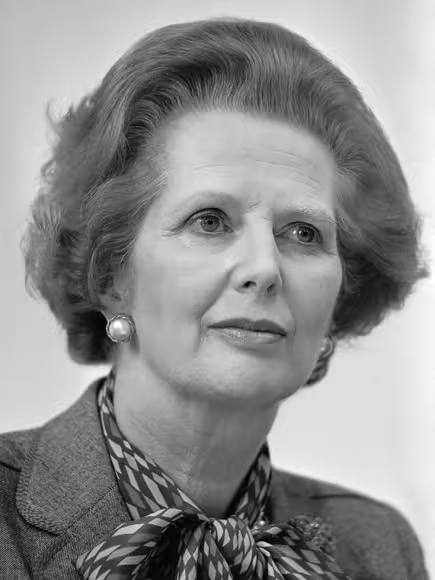
On October 13, 1925, Margaret Hilda Roberts, later known as Margaret Thatcher, was born in Grantham, Lincolnshire. The daughter of a grocer, she would become Britain’s first woman prime minister and a defining figure in twentieth-century politics. Her eleven years in office changed the country’s economic direction and sparked debates that continued long after her departure.
From Grantham to Oxford
Margaret grew up above her family’s grocery shop. Her father, Alfred Roberts, was active in local government, and discussions about public affairs formed part of her upbringing. She studied chemistry at Somerville College, Oxford, where her tutor was Dorothy Hodgkin, a future Nobel Prize winner.
Politics increasingly attracted her attention. She became president of Oxford’s Conservative Association and later trained as a barrister. In 1959, she entered Parliament as the Conservative member for Finchley.
A Historic Rise to Power
After serving as education secretary, Thatcher became leader of the Conservative Party in 1975. The party’s victory in the 1979 general election brought her to Downing Street, breaking a barrier in British political life.
She subsequently led the Conservatives to election victories in 1983 and 1987. Serving until November 1990, she became Britain’s longest-serving prime minister of the twentieth century.
The “Iron Lady”
Her nickname, the “Iron Lady,” originated in Soviet criticism of her outspoken opposition to the Soviet Union. She embraced the label, which became closely associated with her determined public image.
Her governments pursued privatisation, reduced trade union powers and promoted a greater role for markets. Abroad, she developed a close relationship with US President Ronald Reagan, led Britain during the 1982 Falklands War and established a dialogue with Soviet leader Mikhail Gorbachev.
An Influential and Contested Legacy
Thatcher’s policies attracted strong support and fierce opposition. Admirers credited her with restoring economic confidence and strengthening Britain’s international standing. Critics emphasised unemployment, industrial decline and the social costs of her reforms.
She died on April 8, 2013. Her career remains a major chapter in British history: both a milestone for women in political leadership and a source of continuing debate about government, markets and society.
Other Events on This Day
- Greenwich Is Chosen as the World’s Prime Meridian
- Yves Montand, the Italian-Born Singer Who Became a Star of French Cinema, Is Born
Credits: 1st photo: Photo: Rob Bogaerts / Anefo, September 19, 1983. Nationaal Archief, via Wikimedia Commons. CC0 1.0 Universal. Sources: GOV.UK — History of Baroness Thatcher; Margaret Thatcher Foundation — Biography


