
Dec
25
25
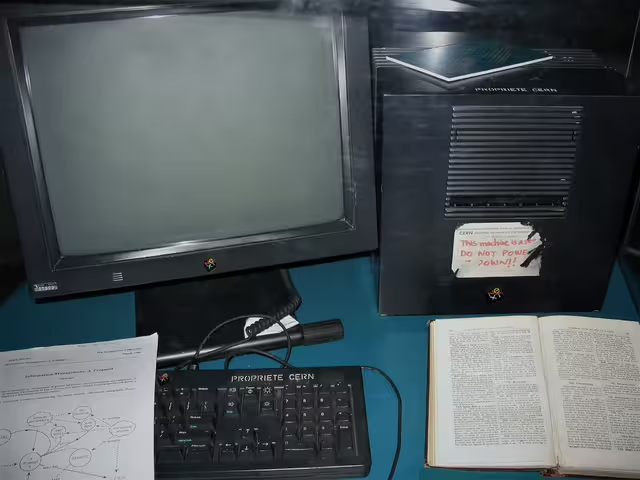
By Christmas 1990, Tim Berners-Lee had brought the essential components of the World Wide Web to life at CERN, the European particle physics laboratory near Geneva. A browser, a server and linked pages were turning an ambitious proposal into a working system for sharing information.
From a Proposal to a Working Web
Berners-Lee first proposed his information-management system in March 1989. Researchers needed better ways to find and connect material stored across different computers. Hypertext offered a solution: documents could contain links leading readers directly to related information.
In November 1990, Berners-Lee and CERN colleague Robert Cailliau presented a formal proposal for the project. By the Christmas holidays, its central ideas had become working software.
A Browser That Could Also Edit
Using a NeXT computer, Berners-Lee created the first browser, called WorldWideWeb. It was also an editor, reflecting his vision of a medium in which people could contribute information as well as read it.
The first web server ran at CERN, and the earliest website explained the project itself. Together, HTML, HTTP and web addresses provided the foundations for describing documents, transferring them and locating resources.
What Does December 25 Actually Mark?
The first edition of the browser carried the date December 25, 1990. However, Berners-Lee later explained that this was a playful choice: the software had been prepared before the Christmas closure, and he was not working on Christmas Day.
The historical milestone is therefore best described as a functioning web by Christmas 1990, rather than a first successful test known to have taken place on December 25.
Opening the Door to a Wider World
The Web did not create the internet. It introduced a way to navigate and share linked information over an existing network infrastructure.
On August 6, 1991, Berners-Lee announced the project to a wider audience through the alt.hypertext newsgroup. CERN’s decision to release the web software into the public domain on April 30, 1993, further encouraged its adoption. The small system working at CERN over Christmas 1990 had become the starting point for a new way of publishing, learning and communicating.
Other Events on This Day
- Ephraim McDowell Performs a Pioneering Operation That Changes Abdominal Surgery
- The James Webb Space Telescope Launches on Its Journey to Explore the Universe
Credits: 1st photo: Coolcaesar at English Wikipedia, 2005, via Wikimedia Commons, licensed under CC BY-SA 3.0. Colour and clarity adjusted in the linked version. Sources: Tim Berners-Lee — The WorldWideWeb Browser; CERN — World Wide Web at 35; CERN — WWW Project History; W3C — 25 Years Ago the World Changed Forever


