
Dec
25
25
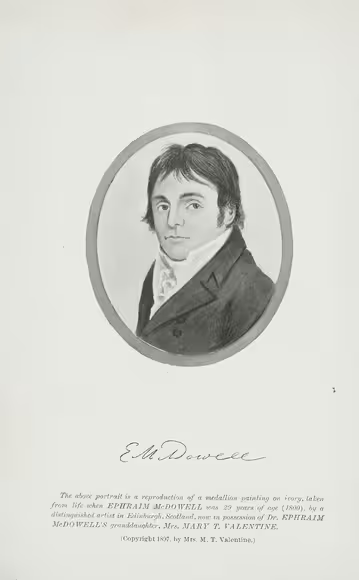
On Christmas Day in 1809, American physician Ephraim McDowell removed a massive ovarian tumour from Jane Todd Crawford at his home in Danville, Kentucky. Performed without general anaesthesia, the operation became recognised as the first successful ovariotomy and a landmark in the development of abdominal surgery.
A Diagnosis That Changed Everything
Crawford’s swollen abdomen had initially been mistaken for an overdue pregnancy. When McDowell examined her, he concluded that she was suffering from an ovarian tumour.
Removing it would require a dangerous operation. At the time, opening the abdominal cavity carried a severe risk of infection and death. McDowell explained the uncertainty to Crawford, who chose to proceed. She travelled approximately 60 miles to Danville on horseback to place herself under his care.
An Extraordinary Christmas Day Operation
On December 25, McDowell operated in his own home. The procedure took approximately 25 minutes, with Crawford remaining conscious. Modern general anaesthesia and antiseptic surgery had not yet been introduced.
The tumour and its contents weighed about 22.5 pounds, or just over 10 kilograms. Its size made removal particularly difficult. McDowell’s account describes careful work and attention to cleaning the abdominal cavity before closing the incision.
The achievement depended on both surgical skill and the extraordinary endurance of the patient. Crawford faced an ordeal whose outcome neither she nor her surgeon could confidently predict.
A Recovery That Defied Expectations
Crawford survived and recovered. According to the historical accounts, she was able to return home about 25 days after the operation. She lived until 1842, more than three decades after the procedure.
Her recovery demonstrated that a planned operation to remove a large ovarian tumour could succeed, challenging widespread pessimism about surgery within the abdomen.
A Turning Point, Not an Instant Revolution
McDowell published his first report of successful ovarian operations in 1817. His results attracted attention, but abdominal surgery remained hazardous. Later advances in anaesthesia, infection prevention and surgical technique were essential before such procedures could become more widely and safely practised.
The Christmas operation of 1809 remains an important milestone in that longer history. It is also the story of Jane Todd Crawford, whose decision and survival were central to a breakthrough often remembered primarily through her surgeon’s name.
Other Events on This Day
- The James Webb Space Telescope Launches on Its Journey to Explore the Universe
- The World Wide Web Takes Shape at CERN
Credits: 1st photo: Unknown artist, c. 1800. Reproduced in Biography of Ephraim McDowell, M.D. (1897), via Wikimedia Commons. Public domain. Sources: Annals of Surgery — Ephraim McDowell: The Qualities of a Good Surgeon; Arizona State University — Ephraim McDowell (1771–1830); Indiana Historical Bureau — Grave of Jane Todd Crawford


