
Dec
25
25
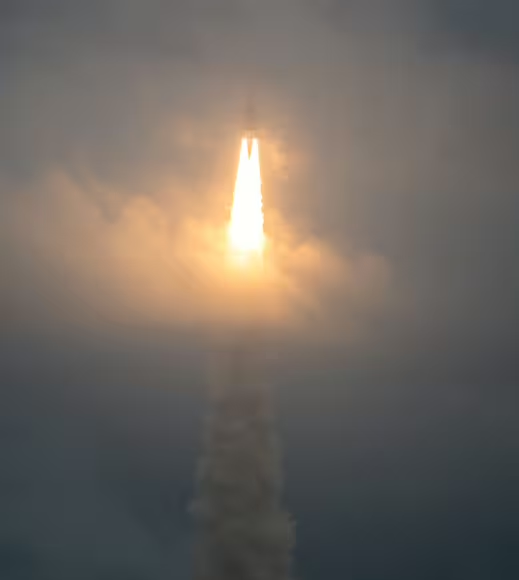
On December 25, 2021, the James Webb Space Telescope lifted off aboard an Ariane 5 rocket from Europe’s Spaceport in Kourou, French Guiana. Launching at 12:20 UTC, the observatory began a journey that would open new possibilities for studying distant galaxies, the birth of stars and planets, and worlds beyond our Solar System.
A Christmas Launch for an International Mission
Webb was developed through an international partnership led by NASA, working with the European Space Agency and the Canadian Space Agency. ESA provided the launch service, with Arianespace operating the Ariane 5 rocket.
Approximately 27 minutes after liftoff, the telescope separated from the rocket’s upper stage. Its solar array deployed shortly afterwards, supplying electrical power as the observatory continued towards its destination.
A Telescope Designed to Unfold in Space
Webb’s primary mirror measures 6.5 metres across and consists of 18 gold-coated segments. Its mirror wings and enormous sunshield had to be folded to fit inside the rocket, then carefully deployed after launch.
The five-layer sunshield protects the telescope from sunlight and helps keep its instruments cold enough to detect faint infrared radiation. Completing these deployments was a crucial part of preparing Webb for scientific observations.
Looking Back Through Cosmic Time
Webb observes primarily in infrared light. This allows it to study distant galaxies whose light has been stretched to longer wavelengths by the expansion of the Universe. Because that light has travelled for billions of years, these observations reveal galaxies as they appeared in the distant past.
Its instruments also investigate star-forming regions and the atmospheres of planets orbiting other stars. Webb’s scientific value extends beyond striking images: measurements of light reveal information about the objects’ composition and physical conditions.
From Launch to Discovery
On January 24, 2022, Webb entered its planned orbit around the Sun–Earth system’s second Lagrange point, known as L2, approximately 1.5 million kilometres from Earth. Months of cooling, mirror alignment and instrument testing followed.
The first full set of scientific images and spectra was released on July 12, 2022. The Christmas Day launch had carried an international observatory into space; the observations that followed began turning its ambitious scientific goals into discoveries.
Other Events on This Day
- Ephraim McDowell Performs a Pioneering Operation That Changes Abdominal Surgery
- The World Wide Web Takes Shape at CERN
Credits: Photo: NASA/Bill Ingalls, December 25, 2021, via Wikimedia Commons. Public domain. Sources: NASA — Webb Launch; NASA — James Webb Space Telescope; ESA/Webb — Fact Sheet; ESA — Webb Deployment Complete; ESA — Webb Has Arrived at L2; ESA/Webb — Press Releases 2022


