Aug
28
28
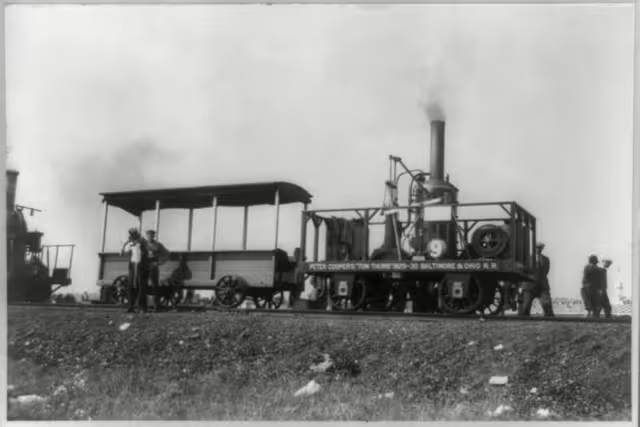
On August 28, 1830, Peter Cooper's experimental steam locomotive, later known as the Tom Thumb, made a historic demonstration run on the Baltimore & Ohio Railroad — and became linked to one of the most famous races in early American railway history.
The event helped show that steam power could become a practical alternative to horses and pointed toward the future of rail transportation in the United States.
A Railway Still Powered by Horses
In the early days of the Baltimore & Ohio Railroad, trains were not yet pulled mainly by locomotives.
Horse-drawn railcars were still common, and it was not obvious that steam engines would become the standard form of railway power.
American inventor and businessman Peter Cooper believed otherwise.
He built a small experimental locomotive designed to prove that a steam engine could operate successfully on the B&O's relatively light and sharply curved tracks.
The Tom Thumb
The locomotive was compact and unusual, with a vertical boiler and exposed mechanical parts.
It was not designed as a finished production model. Instead, it was essentially a proof of concept.
Cooper wanted to demonstrate that a small steam locomotive could pull passengers and operate reliably on an American railroad.
The locomotive later became known as the Tom Thumb, after the tiny character from traditional folklore.
The Historic Run
On August 28, 1830, Cooper took officials of the Baltimore & Ohio Railroad on a demonstration journey between Baltimore and Ellicott's Mills, now Ellicott City, Maryland.
The locomotive successfully pulled a passenger car and reached speeds of roughly 10 to 15 miles per hour.
For the time, the performance was impressive.
It showed that steam power was not just a theoretical idea. It could actually move people along a working railway.
Steam Versus Horse
According to the traditional story, the Tom Thumb later found itself running alongside a horse-drawn railcar on a parallel track.
A spontaneous race followed.
The horse initially accelerated more quickly, but once the locomotive built up steam, the Tom Thumb began to catch up and move ahead.
Then the locomotive suffered a mechanical problem.
A belt connected to its blower reportedly slipped from its pulley, causing the engine to lose power.
While Cooper tried to repair it, the horse passed the locomotive and won the race.
The Horse Won — but Steam Won the Future
The result of the race did not damage the reputation of the locomotive.
Quite the opposite.
The demonstration had already shown that steam engines could reach higher sustained speeds and potentially move much heavier loads than horses.
The mechanical failure was seen as a problem that could be solved through better engineering.
Within a short time, steam locomotives began replacing horse power on the Baltimore & Ohio Railroad.
The race became a perfect symbol of a larger technological transition: the horse may have won that day, but the locomotive won the future.
How Certain Is the Famous Race?
There is one important historical detail.
The Tom Thumb's demonstration run on August 28, 1830, is well established, but the famous horse race is more difficult to document with contemporary evidence.
Much of the detailed story was recorded years later, and the B&O Railroad Museum notes that the race has become part history and part railway folklore.
Even so, the story reflects a very real technological competition taking place at the time between animal power and steam power.
The Original Tom Thumb Was Lost
The original locomotive did not survive.
Because it had been built mainly as an experimental machine, it was eventually dismantled and its components were reused.
The Tom Thumb seen today in museums and historical photographs is a working replica built in 1927 for the Baltimore & Ohio Railroad's centennial celebrations.
The Beginning of the American Steam Railway Era
The Tom Thumb was small, experimental, and mechanically imperfect.
But its importance was much greater than its size.
Its successful demonstration helped prove that steam locomotives could become practical machines for American railroads.
During the following decades, steam-powered railways spread rapidly across the United States, carrying passengers, freight, mail, and raw materials over increasingly long distances.
What began as a short experimental journey in Maryland became part of a transportation revolution that would help reshape the country.
Other Events on This Day
- Britain Approves the Slavery Abolition Act
- Pedro Menéndez Sights Florida — and St. Augustine Gets Its Name
Credits: Photo: Library of Congress — Public Domain.