Aug
28
28
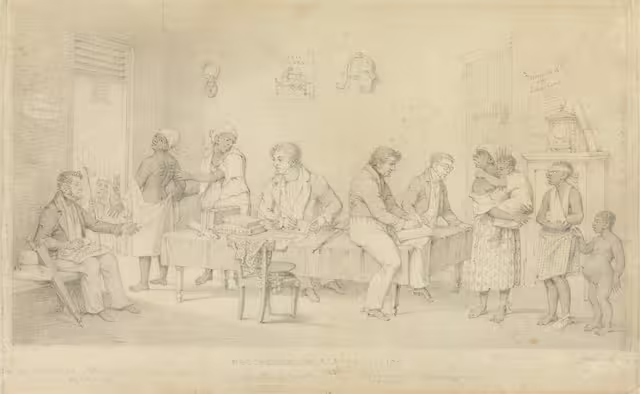
On August 28, 1833, the Slavery Abolition Act received Royal Assent, setting in motion the legal abolition of slavery across most of the British Empire.
The law was a major turning point in British and imperial history. It did not free every enslaved person immediately, and it did not apply everywhere, but it marked the beginning of the end of legal slavery across much of the empire.
From Ending the Slave Trade to Ending Slavery
Britain had already outlawed its participation in the transatlantic slave trade in 1807.
That law stopped British involvement in the buying and transporting of enslaved people across the Atlantic, but it did not abolish slavery itself.
Hundreds of thousands of people remained enslaved on plantations and in households across British colonies, especially in the Caribbean.
The Slavery Abolition Act of 1833 went much further by attacking the legal institution of slavery itself.
More Than 800,000 People Affected
The law affected more than 800,000 enslaved people, primarily in British colonies in the Caribbean, as well as in places such as Mauritius and the Cape Colony.
Its passage followed decades of pressure from abolitionists, religious groups, campaigners, formerly enslaved people, and members of the British public.
Resistance by enslaved people themselves also played an important role in making the system increasingly difficult to defend.
Abolition Did Not Mean Immediate Freedom
The law received Royal Assent on August 28, 1833, but its main provisions did not take effect until August 1, 1834.
Even then, freedom was not complete.
Children under the age of six were freed immediately, but many older enslaved people were placed into a system known as “apprenticeship.”
Under this arrangement, they were legally no longer slaves, but were still required to work for their former owners for part of the week without normal wages.
The system was heavily criticized and was finally ended in 1838, earlier than originally planned.
The Law Did Not Cover the Entire Empire
The 1833 Act is often described as abolishing slavery throughout the British Empire, but this is not completely accurate.
Several territories were excluded from the law, including areas controlled by the East India Company, as well as Ceylon and Saint Helena.
For that reason, it is more accurate to say that the Act abolished slavery across most of the British Empire.
Compensation Went to Slave Owners
One of the most controversial parts of the Act was its compensation scheme.
The British government set aside £20 million to compensate slave owners for the loss of what the law had previously treated as their property.
This was an enormous sum at the time, equal to roughly 40 percent of the government's annual expenditure.
The people who had been enslaved received no financial compensation.
Many of them were instead required to continue working under the apprenticeship system for several more years.
Decades of Abolitionist Pressure
The passage of the Act was the result of a long political struggle.
Campaigners such as William Wilberforce had spent decades arguing against slavery and the slave trade.
Wilberforce died in July 1833, only weeks before the Act received Royal Assent.
But the movement was much broader than a few famous politicians.
Black abolitionists, formerly enslaved people, religious organizations, petition campaigns, and resistance within the colonies all contributed to the growing pressure for change.
Resistance in the Caribbean
One major event was the Baptist War in Jamaica in 1831 and 1832, also known as the Sam Sharpe Rebellion.
Tens of thousands of enslaved people took part in the uprising.
British authorities suppressed it violently, but the rebellion demonstrated how unstable and unsustainable the slave system had become.
Events like this strengthened the political argument for abolition.
A Major Step Toward Emancipation
The Slavery Abolition Act did not create immediate and complete freedom across the entire British Empire.
Its exclusions, compensation for slave owners, and apprenticeship system reveal how incomplete and compromised the process was.
Even so, August 28, 1833, marked a major legal turning point.
For the first time, the British state formally committed itself to dismantling slavery across most of its colonies.
The process would take years to complete, but the law helped bring legal freedom to hundreds of thousands of people and permanently changed the structure of the British Empire.
Other Events on This Day
- Pedro Menéndez Sights Florida — and St. Augustine Gets Its Name
- The Tom Thumb Races a Horse — and Steam Wins the Future
Credits: 1st photo: Yale Center for British Art — Public Domain