Aug
27
27
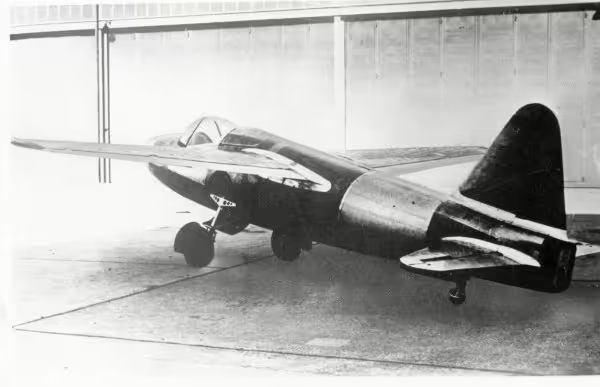
On August 27, 1939, the Heinkel He 178 made the world's first successful flight by an aircraft powered solely by a turbojet engine.
The flight lasted only a few minutes, but it marked the beginning of a technological revolution that would eventually transform both military and civilian aviation.
A Completely New Kind of Aircraft
Until the late 1930s, almost all powered aircraft relied on piston engines turning propellers.
The Heinkel He 178 was different.
Instead of using a propeller, it was powered by a turbojet engine that compressed air, mixed it with fuel, burned the mixture, and expelled hot gases at high speed to create thrust.
The principle would later become the foundation of modern jet aviation.
The Historic Flight
The first flight took place on August 27, 1939, at Heinkel's airfield near Rostock, Germany.
At the controls was experienced test pilot Erich Warsitz.
The small experimental aircraft remained in the air for only several minutes, but the flight proved something that had never been demonstrated before: an airplane could successfully fly using turbojet power alone.
It was a short flight with enormous consequences.
Hans von Ohain and the Jet Engine
The engine behind the He 178 was developed by German physicist and engineer Hans von Ohain.
Von Ohain had been working on the idea of jet propulsion since the early 1930s. His work attracted the attention of aircraft manufacturer Ernst Heinkel, who provided financial and technical support.
The aircraft was powered by a Heinkel HeS 3 turbojet, one of the world's earliest practical jet engines.
Heinkel largely supported the project as a private technological experiment rather than as a direct military requirement.
A Parallel Race in Britain
Germany was not alone in developing jet propulsion.
In Britain, engineer and Royal Air Force officer Frank Whittle had independently been working on a similar concept.
Whittle had patented ideas for a turbojet engine years earlier and successfully tested a working engine on the ground in 1937.
However, Germany won the race to put a turbojet-powered aircraft into the air.
The British experimental Gloster E.28/39, powered by a Whittle-designed engine, made its first flight in May 1941 — almost two years after the He 178.
Just Days Before World War II
The timing of the He 178's first flight was extraordinary.
It took place only five days before Germany invaded Poland on September 1, 1939, beginning World War II in Europe.
A technology that would soon become closely associated with military aircraft first entered the sky at the very moment Europe was descending into war.
Yet the He 178 itself was never intended to become a combat aircraft.
The Military Was Not Immediately Convinced
Despite the successful demonstration, German military officials did not immediately embrace jet aviation.
Early jet engines were still experimental. They consumed large amounts of fuel, had limited operating lives, and required materials and manufacturing techniques that were difficult to perfect.
The He 178 was therefore mainly a technology demonstrator.
Only one prototype was built, and it never entered production.
From the He 178 to the Me 262
The successful flight nevertheless proved that jet propulsion was practical.
Heinkel continued experimenting with jet aircraft, including the more advanced twin-engine Heinkel He 280.
During World War II, the most famous German jet aircraft became the Messerschmitt Me 262, which entered combat service in 1944 and became the world's first operational jet-powered fighter.
Britain also introduced the Gloster Meteor during the war.
Within only a few years, the experimental technology demonstrated by the He 178 had begun moving toward military service.
The Original Aircraft Did Not Survive
The historic He 178 prototype was eventually placed in a museum collection.
It did not survive World War II and was destroyed during an Allied bombing raid in 1943.
Today, replicas and historical photographs preserve the appearance of the small aircraft that played such an important role in aviation history.
The Beginning of the Jet Age
The Heinkel He 178 never carried passengers, entered combat, or reached mass production.
Its importance lies entirely in what it proved.
On August 27, 1939, a small experimental aircraft showed that aviation no longer needed to depend on propellers.
The basic technology demonstrated during that brief flight would eventually power commercial airliners, military fighters, and aircraft traveling faster and farther than the pioneers of the 1930s could have imagined.
The jet age had begun.
Other Events on This Day
Credits: 1st photo: San Diego Air & Space Museum Archives / Ray Wagner Collection — No known copyright restrictions.