Aug
27
27
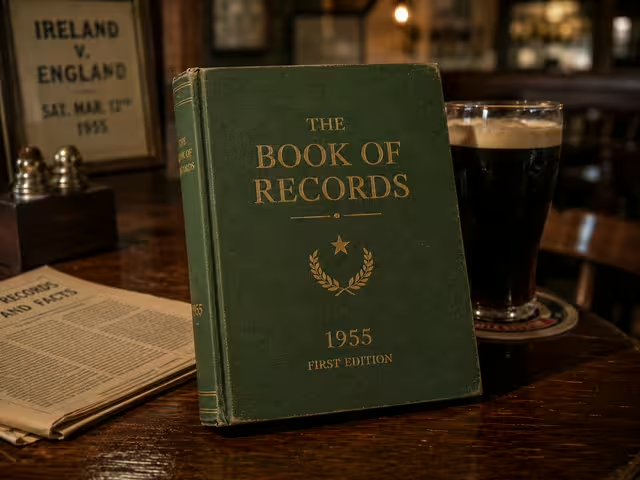
On August 27, 1955, the first edition of The Guinness Book of Records was completed and began the story of what would become one of the world's most famous reference books.
What started as a clever idea for settling arguments over facts and records soon became an international publishing phenomenon.
An Argument That Started It All
The idea for the book can be traced back to Sir Hugh Beaver, managing director of the Guinness brewery.
During a shooting party in Ireland in 1951, Beaver became involved in a debate about which European game bird was the fastest.
The group could not find an authoritative reference book that provided a clear answer.
Beaver realized that similar arguments probably happened every day in pubs across Britain and Ireland.
Why not create a book filled with reliable answers to unusual questions and records?
The McWhirter Twins
To turn the idea into reality, Guinness worked with identical twin brothers Norris and Ross McWhirter.
The brothers ran a London research agency and had a remarkable ability to collect, verify, and organize facts.
They contacted experts in fields ranging from science and engineering to zoology, geography, and sport.
The first edition was assembled in only a few months.
A Small Green Book
The original Guinness Book of Records looked very different from the large, colorful editions familiar today.
It contained around 198 pages and was bound in green with gold lettering.
The book was divided into sections covering subjects such as the natural world, science, technology, human achievements, buildings, and sport.
Its first print run numbered approximately 50,000 copies.
Built for the Pub
The book had strong connections to Guinness pubs from the beginning.
Some copies were distributed as promotional material, helping customers and pub owners settle debates about records and unusual facts.
Certain early editions even used especially durable bindings because the books were expected to survive heavy use in busy pubs.
What began as a marketing idea quickly proved far more popular than expected.
An Instant Success
By Christmas 1955, the book had become a bestseller in Britain.
Readers clearly enjoyed having a single volume containing extraordinary facts, extreme achievements, and answers to questions they might never have thought to ask.
The following year, an American edition appeared, helping the book reach an even wider audience.
August 27 or October 3?
There is an interesting detail surrounding the book's exact publication date.
Guinness World Records celebrates August 27, 1955 as its official birthday and the beginning of the first edition.
However, its own historical archive also lists October 3, 1955 as the formal publication date for the book's release into the market.
The difference appears to reflect the date when the first edition was completed and bound versus its later commercial publication.
From Book to Global Brand
The success of the first edition led to annual updates and increasingly international editions.
Over time, the book expanded beyond traditional facts and statistics to include remarkable human achievements, unusual collections, engineering feats, natural records, and extraordinary skills.
The publication eventually became known as Guinness World Records.
Records Become Entertainment
Part of the book's lasting appeal came from the way it combined serious verification with entertainment.
Readers could learn about the tallest buildings, fastest animals, deepest oceans, strongest athletes, or most unusual achievements all in one place.
For many people, the book became an annual tradition.
A Simple Idea With a Lasting Legacy
The story of The Guinness Book of Records is a reminder that successful ideas can begin with very ordinary questions.
A disagreement during a shooting trip led to a reference book designed to settle arguments.
That book then became a global institution celebrating facts, curiosity, competition, and the limits of human achievement.
On August 27, 1955, the first edition marked the beginning of a publishing tradition that would continue for generations.
Other Events on This Day