Aug
27
27
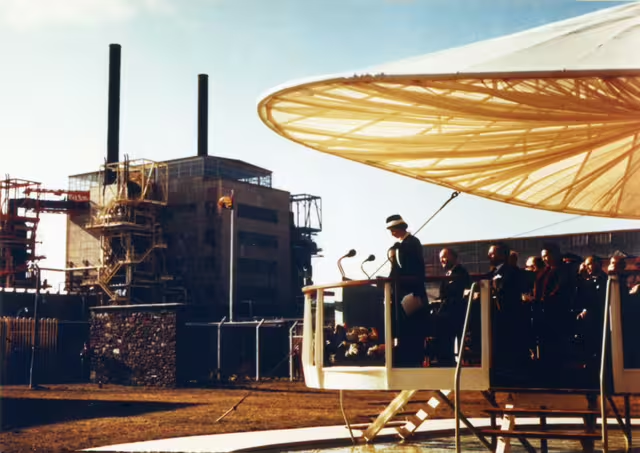
On August 27, 1956, Calder Hall in the United Kingdom began supplying electricity to the national grid, becoming the world's first full-scale commercial nuclear power station to generate electricity on an industrial scale.
The moment marked an important turning point in the history of energy. For the first time, nuclear power was being used not just as an experiment, but as part of a large-scale electricity system serving ordinary consumers.
A New Kind of Power Station
Calder Hall was built in Cumbria, on the site now known as Sellafield.
Its reactors used a British design called Magnox. They were fueled with natural uranium, moderated by graphite, and cooled with carbon dioxide gas.
The basic principle was similar to that of a conventional thermal power station: heat was used to produce steam, the steam drove turbines, and the turbines powered electrical generators.
The difference was the source of the heat. Instead of burning coal or oil, Calder Hall used nuclear fission.
August 27, 1956
The first Calder Hall reactor had reached criticality in July 1956.
On August 27, it was connected to Britain's National Grid and began supplying electricity beyond the station itself.
The event demonstrated that nuclear energy could be integrated into a national power network on a commercial and industrial scale.
Several weeks later, on October 17, 1956, Queen Elizabeth II officially opened Calder Hall in a ceremony attended by representatives from dozens of countries.
Was It Really the World's First Nuclear Power Station?
Calder Hall's claim to being the first requires one important distinction.
Two years earlier, in 1954, the Soviet Union had connected a small nuclear power plant at Obninsk to the electricity grid. It is generally recognized as the world's first nuclear power station to supply electricity to a public network.
Calder Hall, however, was different in scale and purpose.
It became the world's first full-scale commercial nuclear power station, designed to generate substantial amounts of electricity as part of a national energy system.
That distinction made it a major milestone in the development of civilian nuclear power.
Four Reactors and a New Energy Industry
Calder Hall eventually operated with four reactors, supported by turbine halls and large cooling towers.
Together, the reactors produced roughly 190 megawatts of electricity.
By modern standards, that output is relatively small. A single modern nuclear reactor can produce several times as much power.
In the 1950s, however, Calder Hall represented an extraordinary technological achievement and a glimpse of what many believed would be the future of electricity generation.
The Optimism of the Atomic Age
The opening of Calder Hall took place only eleven years after the atomic bombings of Hiroshima and Nagasaki.
During the 1950s, governments and scientists increasingly promoted the idea that nuclear technology could be used for peaceful purposes as well as weapons.
Nuclear power came to symbolize technological progress, scientific ambition, and the possibility of producing large amounts of energy from relatively small quantities of fuel.
Calder Hall became one of the most visible symbols of that optimism.
Energy and the Cold War
The history of Calder Hall was also closely connected to Britain's nuclear weapons program.
Early Magnox reactors could produce plutonium in their spent fuel, and the wider Sellafield complex already played an important role in Britain's military nuclear activities.
This meant that the boundary between civilian nuclear energy and military nuclear technology was not always clear in the early years of the atomic age.
Calder Hall was therefore both a power station and part of a much larger story about science, national security, and the Cold War.
Far Beyond Its Expected Lifetime
Calder Hall had originally been expected to operate for around twenty years.
Instead, it remained in service for nearly half a century.
The station finally stopped generating electricity on March 31, 2003, after approximately 47 years of operation.
By then, nuclear power had become an established part of electricity generation in many countries around the world.
A Milestone in the Nuclear Age
The connection of Calder Hall to the grid on August 27, 1956, did not mark the first time electricity had ever been generated by a nuclear reactor.
What it represented was something larger: the beginning of full-scale commercial nuclear power.
A technology that had emerged from wartime nuclear research was now being used to light homes, power factories, and feed electricity into a national grid.
Calder Hall helped open a new chapter in the history of global energy — one whose technological, political, and environmental consequences are still being debated today.
Other Events on This Day
Credits: 1st photo: UK Government — Open Government Licence v3.0.