Aug
26
26
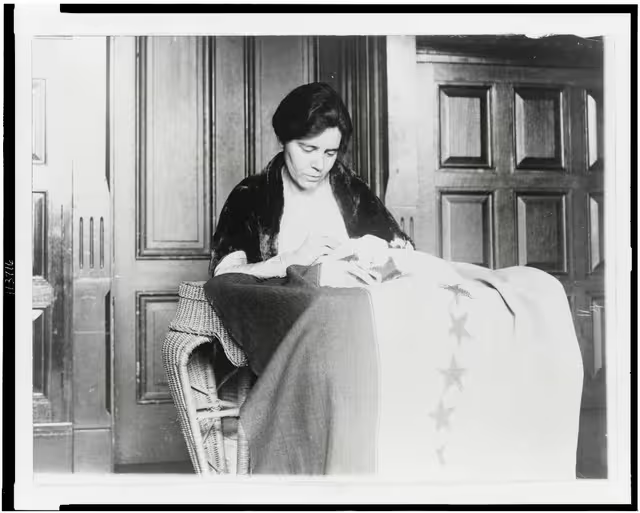
On August 26, 1920, the 19th Amendment to the U.S. Constitution was officially certified, prohibiting the United States from denying voting rights on the basis of sex.
The certification marked the culmination of a decades-long struggle for women's suffrage in the United States and became one of the most important milestones in the history of American democracy.
A Campaign That Lasted Generations
The fight for women's voting rights had begun long before 1920.
One of its best-known early milestones was the Seneca Falls Convention of 1848, where activists publicly demanded greater political and legal rights for women.
Over the following decades, suffragists organized petitions, lectures, marches, political campaigns, and demonstrations. Some activists were arrested and imprisoned for their protests.
Among the movement's most prominent figures were Elizabeth Cady Stanton, Susan B. Anthony, Carrie Chapman Catt, and Alice Paul.
The Amendment Reaches Congress
A federal constitutional amendment for women's suffrage was first introduced in Congress in 1878.
It took more than forty years before enough political support existed to pass it.
The House of Representatives approved the amendment in May 1919, and the Senate followed on June 4, 1919.
The proposed amendment then had to be ratified by three-fourths of the states. With 48 states in the Union at the time, approval from 36 states was required.
Tennessee Casts the Deciding Vote
By the summer of 1920, 35 states had ratified the amendment.
The final battle took place in Tennessee.
Supporters and opponents of women's suffrage filled the state capitol, with supporters often wearing yellow roses and opponents wearing red ones.
On August 18, 1920, Tennessee became the 36th state to approve the amendment.
One of the most famous moments came when 24-year-old legislator Harry T. Burn, who had previously been associated with the opposition, voted in favor of ratification after receiving a letter from his mother urging him to support women's suffrage.
August 26, 1920
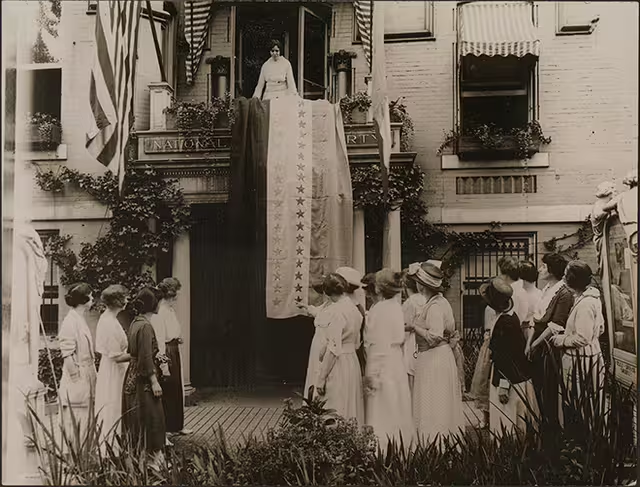
Eight days after Tennessee's decisive vote, U.S. Secretary of State Bainbridge Colby signed the official proclamation certifying the 19th Amendment as part of the Constitution.
The certification took place on the morning of August 26, 1920.
Despite the enormous historical importance of the moment, there was no grand public ceremony. The document was signed quietly, without photographers or film cameras present.
What Did the 19th Amendment Change?
The amendment states that the right of U.S. citizens to vote cannot be denied or restricted “on account of sex.”
This meant that states could no longer legally exclude women from voting simply because they were women.
It transformed the American electorate and opened national elections to millions of new voters.
Not Every Woman Could Vote Freely
The 19th Amendment was a major victory, but it did not immediately guarantee equal access to the ballot for every American woman.
Black women, particularly in the South, continued to face discriminatory barriers such as literacy tests, poll taxes, intimidation, and other restrictions associated with the Jim Crow system.
Native American women and some Asian American women also faced citizenship laws and other legal obstacles that could prevent them from voting.
Many of these barriers remained in place for decades and were challenged by later civil rights legislation, including the Voting Rights Act of 1965.
A Lasting Symbol of Political Equality
The 1920 presidential election was the first U.S. presidential election held after the amendment became part of the Constitution, and millions of women participated.
Some women had already gained voting rights in individual states before 1920, especially in the western United States, but the 19th Amendment established the principle nationally.
Today, August 26 is observed in the United States as Women's Equality Day, commemorating the certification of the amendment and the generations of activists who fought for political equality.
The events of August 26, 1920, did not end the struggle for equal voting rights, but they permanently changed the Constitution and reshaped American democracy.
Other Events on This Day
Credits: 1st photo: Library of Congress / National Woman’s Party Records; 2nd photo Library of Congress / National Woman’s Party Records