Aug
26
26
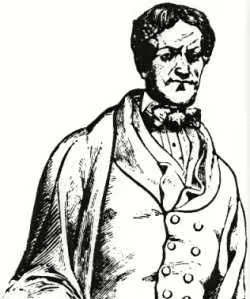
On August 26, 1791, American inventor John Fitch received a federal patent for methods of propelling boats by steam. His work helped lay the foundations for the steamboat era years before steam-powered river travel became commercially successful.
Although Robert Fulton would later become the name most closely associated with early steamboats in the United States, Fitch had already built, tested, and operated working steam-powered vessels decades earlier.
An Inventor Fascinated by Steam
John Fitch was born in Connecticut in 1743 and worked in several trades before becoming deeply interested in the possibilities of steam power.
During the 1780s, he began experimenting with ways to use steam engines to propel boats.
At the time, steam technology was still developing rapidly, and applying it reliably to transportation was a major engineering challenge.
A Public Demonstration on the Delaware
On August 22, 1787, Fitch publicly demonstrated a steam-powered boat on the Delaware River near Philadelphia.
The vessel was about 45 feet long and used a steam engine to operate a system of mechanical paddles.
Some delegates attending the Constitutional Convention in Philadelphia were reportedly among those who witnessed his experiments.
The demonstration proved that steam power could move a vessel against river currents without relying on wind or human muscle.
Mechanical Paddles Instead of a Paddle Wheel
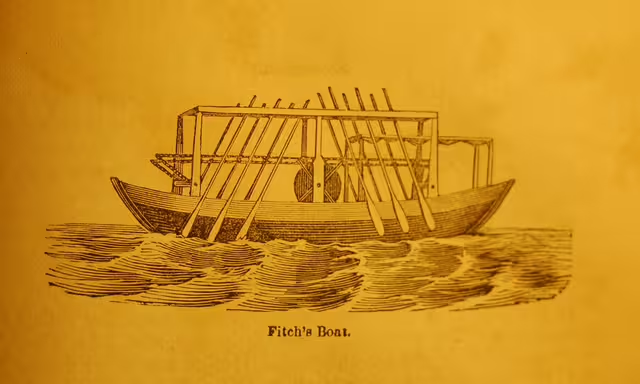
Fitch's early boats did not yet resemble the classic paddle-wheel steamers that would become common in the 19th century.
Instead, his steam engine powered a series of paddles that moved in a repeated rowing motion.
He continued experimenting with different propulsion systems, constantly searching for a design that was both reliable and efficient.
Regular Passenger Service
By 1790, Fitch had built a larger and more advanced vessel that operated on the Delaware River between Philadelphia and towns such as Burlington, New Jersey.
The boat carried both passengers and freight.
It even operated according to a regular schedule, making it one of the earliest examples of practical steam-powered passenger transportation.
For a brief time, Fitch had turned what seemed like an experimental invention into a functioning transportation service.
The Patent of 1791
Fitch wanted legal protection for his steam-powered navigation technology.
On August 26, 1791, he received a United States patent covering several methods of using steam to propel boats.
The patent was issued during the earliest years of the American patent system and was signed under the administration of President George Washington.
Thomas Jefferson, then serving as Secretary of State, was also involved in the young nation's patent process.
He Was Not the Only Inventor
Fitch was not working alone in the race to create a practical steamboat.
Another American inventor, James Rumsey, was developing his own steam-powered propulsion system at the same time.
Rumsey also received a federal patent on August 26, 1791.
Because the two inventors used different technical approaches, the government granted protection to specific methods rather than giving either man exclusive ownership of the general idea of steam navigation.
Why Fitch Did Not Become the Famous Name
Despite proving that steam-powered passenger boats could work, Fitch struggled to make his invention financially successful.
Early steam engines were expensive, difficult to maintain, and inefficient.
He also had trouble finding enough investors willing to support the technology for the long term.
Without sufficient financial backing, his steamboat service eventually ended.
Before Robert Fulton
In 1807, Robert Fulton launched the commercially successful North River Steamboat on the Hudson River.
That vessel, often remembered by the name Clermont, helped establish steam navigation as a profitable form of transportation.
Fulton therefore became much more famous than Fitch.
But Fitch had already demonstrated working steam-powered boats, carried paying passengers, and received a federal patent many years earlier.
A Pioneer Ahead of His Time
John Fitch did not live to see the enormous transformation that steam power would bring to transportation.
During the 19th century, steamboats would become essential to travel and commerce on rivers across the United States and around the world.
They moved passengers, mail, agricultural products, and manufactured goods faster and more reliably than earlier river transport.
A Patent That Marked the Beginning of a New Era
When John Fitch received his patent on August 26, 1791, steam navigation was still experimental technology.
Within a few decades, it would help transform transportation and trade.
Fitch may not have achieved the commercial success he hoped for, but his experiments proved that steam could power regular water transportation.
His work remains an important early chapter in the history of the steamboat — and a reminder that technological pioneers are not always the people who ultimately become the most famous.
Other Events on This Day
Credits: 1st illustration from Lloyd’s Steamboat Directory, 1856 — Public Domain / Wikimedia Commons.; 2st illustration by John F. Watson, published in 1845 — Public Domain / Wikimedia Commons.