Aug
23
23
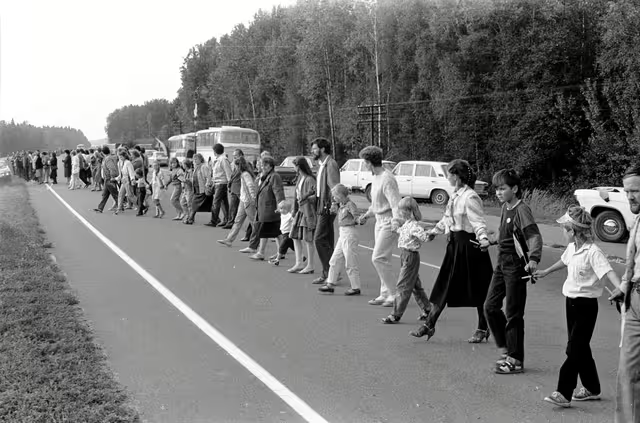
On August 23, 1989, around two million people joined hands across Estonia, Latvia, and Lithuania, forming a human chain more than 600 kilometers long. Their message was peaceful, simple, and impossible to ignore: the Baltic nations wanted their freedom back.
The human chain, known as the Baltic Way, stretched from Vilnius in Lithuania, through Riga in Latvia, to Tallinn in Estonia. At 7:00 PM, people along the entire route joined hands, connecting three nations in one of the largest peaceful demonstrations in modern European history.
Why August 23?
The date carried enormous significance.
Exactly 50 years earlier, on August 23, 1939, Nazi Germany and the Soviet Union signed the Molotov–Ribbentrop Pact. A secret protocol attached to the agreement divided parts of Eastern Europe into German and Soviet spheres of influence.
The Baltic states were among the countries affected. In 1940, the Soviet Union occupied and annexed Lithuania, Latvia, and Estonia, ending their independence.
For decades, Soviet authorities maintained that the Baltic republics had joined the USSR voluntarily. The Baltic independence movements rejected this interpretation and argued that their countries had been illegally occupied.
By choosing the pact's 50th anniversary for their demonstration, participants in the Baltic Way connected their demand for freedom directly to the events of 1939 and 1940.
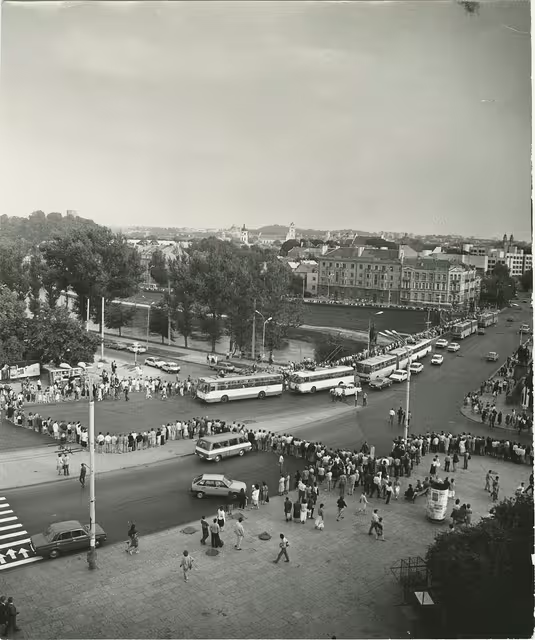
A Human Chain Across Three Countries
Organizing such an enormous demonstration was an extraordinary logistical challenge.
The Baltic independence movements coordinated hundreds of thousands of people across cities, villages, and rural roads. Participants traveled by cars and buses to designated sections of the route. Radio broadcasts helped coordinate the demonstration at a time when there were no mobile phones or social media.
At 7:00 PM, people joined hands.
For hundreds of kilometers, families, students, workers, children, and elderly people stood side by side. Estimates vary, but around two million people are believed to have participated — roughly a quarter of the combined population of the three Baltic republics at the time.
The protest remained peaceful.
Its power came from the image itself: an almost unimaginable line of people physically connecting three nations.
The Road to Independence
The Baltic Way did not immediately end Soviet rule, but it demonstrated how widespread the independence movements had become.
Only months later, in December 1989, the Soviet Congress of People's Deputies condemned the secret protocols of the Molotov–Ribbentrop Pact and declared them legally invalid from the moment they were signed.
Political developments then moved quickly.
Lithuania declared the restoration of its independence on March 11, 1990. Estonia and Latvia followed during the dramatic collapse of Soviet power in August 1991.
By September 1991, all three Baltic states were internationally recognized as independent countries and became members of the United Nations.
A Symbol That Outlived the Soviet Union
Today, the Baltic Way is remembered as one of the most remarkable examples of peaceful political protest of the 20th century.
There were no weapons and no attempt to seize government buildings. Instead, millions of ordinary people used one of the simplest gestures imaginable — holding hands — to make a political statement visible around the world.
In 2009, documentary records of the Baltic Way were added to UNESCO's Memory of the World Register, recognizing its historical importance.
The symbolism of the date remains especially powerful.
On August 23, 1939, two dictatorships secretly negotiated the fate of nations between them.
Exactly 50 years later, the people of Estonia, Latvia, and Lithuania stood together and demanded the right to decide that fate for themselves.
Other Events on This Day
- Europe's Royals Set Sail on the “Cruise of the Kings”
- Louis XVI, France's Last King Before the Revolution, Is Born
Credits: 1st photo by Saulius Gruodis / Lithuanian State Central Archives — CC BY 4.0; 2nd photo by Jonas Kernagis / Lithuanian State Central Archives — CC BY 4.0