Aug
23
23
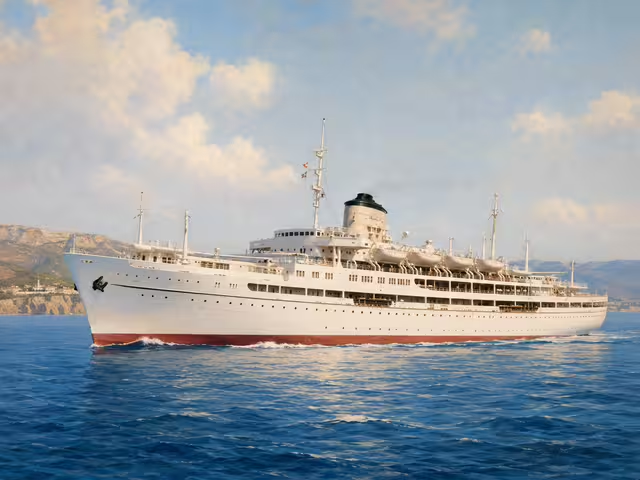
On August 23, 1954, the “Cruise of the Kings” began, bringing together members of more than two dozen European royal families for a remarkable journey through the Mediterranean and the Greek islands.
The voyage was organised by Queen Frederica and King Paul of Greece and combined diplomacy, tourism, family connections, and a touch of royal glamour.
A Floating Gathering of Royal Families
The cruise took place aboard the Greek passenger ship Agamemnon.
Around 110 members of reigning and former royal families were invited, making the voyage one of the largest informal gatherings of European royalty in modern history.
The guest list included kings, queens, princes, and princesses from countries across Europe, including Greece, the Netherlands, Luxembourg, Spain, Italy, Yugoslavia, Denmark, Norway, Sweden, and Romania.
Some represented monarchies that still ruled, while others belonged to royal houses that had already lost their thrones.
Promoting Greece to the World
The cruise had an important practical purpose.
Greece was still recovering from the destruction of World War II and the Greek Civil War, and the government wanted to promote the country as an attractive international travel destination.
The voyage showcased the beauty of the Greek islands, ancient archaeological sites, and Mediterranean culture to some of Europe's most famous families.
It also generated significant international media attention and helped strengthen the image of Greece as a destination for luxury travel and cruising.
A Tour of the Greek Islands
During the journey, the royal guests visited a series of famous locations.
Stops included islands and historic sites such as Corfu, Crete, Rhodes, Santorini, Mykonos, and Skiathos.
The passengers also visited important archaeological and cultural landmarks, including Epidaurus, where they attended a performance of the ancient Greek tragedy Hippolytus.
The trip combined sightseeing, official receptions, swimming, dinners, and informal social events.
Less Formal Than Royal Life Usually Allowed
One of the unusual features of the cruise was its relaxed atmosphere.
Queen Frederica wanted the guests to interact more naturally than they could during formal state visits.
Traditional rules of royal precedence were therefore reduced, allowing younger princes and princesses to spend time together without the rigid ceremony normally associated with European courts.
This gave the voyage a reputation as both a diplomatic gathering and, in the eyes of the press, something of a royal matchmaking cruise.
Royal Romances
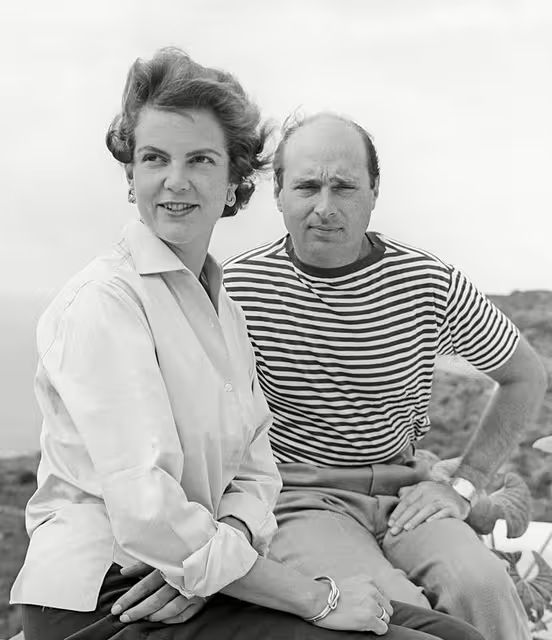
The press was fascinated by the number of young unmarried royals aboard the Agamemnon.
At least one important relationship developed during the voyage.
Prince Alexander of Yugoslavia met Princess Maria Pia of Savoy during the cruise, and the couple married the following year.
The voyage is also remembered as an important early meeting between Princess Sophia of Greece and Prince Juan Carlos of Spain.
They later married in 1962 and eventually became King Juan Carlos I and Queen Sofía of Spain.
A Snapshot of Postwar Europe
The Cruise of the Kings took place during a fascinating period in European history.
Only nine years had passed since the end of World War II.
Several monarchies had disappeared or changed dramatically, while others were trying to redefine their roles in a rapidly modernising Europe.
The voyage brought together people whose families had once ruled large parts of the continent, but who now lived in very different political circumstances.
For a few days, they shared the same ship, visited the same islands, and participated in a deliberately informal social experiment.
A Royal Voyage With a Lasting Image
The cruise ended in early September 1954 after nearly two weeks of travel.
Although it had no major political consequences, it became one of the most memorable royal social events of the 1950s.
It strengthened personal connections between European royal families, attracted international attention to Greece, and helped promote the growing idea of Mediterranean cruising as a form of modern tourism.
What began on August 23, 1954, was part diplomatic gathering, part family reunion, part holiday — and one of the most unusual royal voyages of the 20th century.
Other Events on This Day
- Louis XVI, France's Last King Before the Revolution, Is Born
- The Baltic Way: Two Million People Joined Hands for Freedom
Credits: 2rd photo by Ivo Meldolesi / Mondadori — Public Domain via Wikimedia Commons.