Sep
2
2
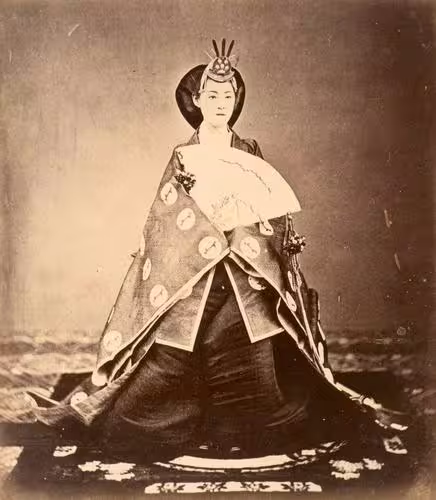
On September 2, 1867, Japan's young ruler Mutsuhito, later known as Emperor Meiji, became engaged to Masako Ichijō. She adopted the name Haruko and would later become Empress of Japan, remembered posthumously as Empress Shōken.
The engagement came at a moment when Japan itself was on the verge of enormous political and social transformation.
A Bride From an Influential Family
Masako Ichijō was born in 1849 into the prestigious Ichijō family, one of the great aristocratic houses of the imperial court.
Her upbringing prepared her for life within the highly traditional world of the Kyoto court.
When she was selected as the future wife of Mutsuhito, she entered a role that would soon become very different from that of earlier Japanese empresses.
From Masako to Haruko
At the time of her engagement in 1867, Masako adopted the name Haruko.
She would be known by this name during her lifetime as empress.
The familiar name Empress Shōken was given to her posthumously after her death in 1914.
A Country in Transition
The engagement took place during one of the most dramatic periods in Japanese history.
The Tokugawa shogunate was losing political authority, while supporters of imperial rule were gaining power.
Within months, the political transformation known as the Meiji Restoration would begin.
Mutsuhito would become the symbolic center of a rapidly modernizing Japanese state.
The Wedding Had to Wait
Although Haruko was chosen as Mutsuhito's bride in September 1867, the couple did not marry immediately.
Political instability, court mourning, and the conflicts surrounding the Meiji Restoration delayed the ceremony.
The marriage finally took place on January 11, 1869.
The ceremony was relatively restrained because Japan was still experiencing the upheaval of the Boshin War and the transition from shogunal to imperial government.
A New Kind of Empress
Haruko became empress during a period when the Japanese imperial court itself was being transformed.
As Japan modernized, the emperor and empress became increasingly visible symbols of the nation.
Haruko gradually assumed a more public role than many earlier imperial consorts.
She appeared at official events, supported charitable causes, and became associated with efforts to present a modern image of the imperial family.
Supporting Women's Education
One of Empress Haruko's most important interests was education for women.
During the Meiji period, Japan rapidly expanded its modern school system.
Haruko supported institutions and initiatives aimed at giving women greater access to education and encouraging their participation in the country's changing society.
Humanitarian Work
The empress also became closely associated with charitable and humanitarian activities.
She supported hospitals, relief work, and organizations assisting people affected by war and disaster.
Her involvement helped strengthen the idea that members of the imperial family could have a visible role in public welfare.
The Japanese Red Cross
Haruko became a major supporter of the Japanese Red Cross Society.
She encouraged humanitarian work and assistance for wounded soldiers and civilians during a period when Japan was becoming increasingly active in international affairs.
Her support for the Red Cross eventually created a legacy that extended far beyond Japan.
The Empress Shōken Fund
In 1912, the empress donated money to support international Red Cross activities during peacetime.
The donation became the foundation of the Empress Shōken Fund.
The fund continues to support humanitarian projects around the world through the international Red Cross and Red Crescent movement.
It remains one of the most enduring international legacies connected with her name.
Modernizing the Imperial Image
Haruko also became part of Japan's effort to present itself as a modern nation on the international stage.
The imperial court gradually adopted elements of Western dress, ceremony, and diplomacy alongside traditional Japanese customs.
Portraits of the emperor and empress became important symbols of the new state.
Haruko therefore lived through a remarkable transition from the traditional court culture of Kyoto to the increasingly modern imperial life of the Meiji era.
Empress Shōken
Haruko died in 1914, two years after Emperor Meiji.
After her death, she received the posthumous name Shōken Kōgō, usually rendered in English as Empress Shōken.
She is today enshrined together with Emperor Meiji at Meiji Jingu in Tokyo.
An Engagement at the Beginning of a New Era
When Masako Ichijō was chosen as Mutsuhito's bride on September 2, 1867, neither of them could have known how dramatically Japan would change during their lives.
The young court aristocrat who became Haruko would witness the fall of the shogunate, the modernization of the Japanese state, and the transformation of the imperial family itself.
Her legacy would extend beyond royal ceremony into women's education, social welfare, and international humanitarian work — making her much more than simply the wife of Emperor Meiji.
Other Events on This Day
- Edinburgh Welcomes Mary, Queen of Scots, With a Spectacular Royal Entry
- Frederick Soddy, the Scientist Who Gave Isotopes Their Name, Is Born
Credits: 1st photo by Uchida Kuichi — Public Domain / Wikimedia Commons.