Sep
2
2
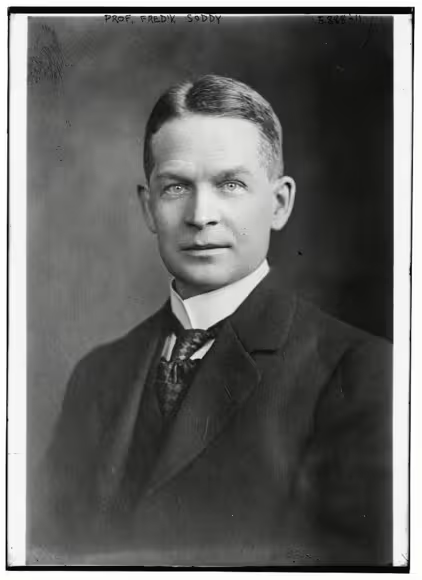
On September 2, 1877, Frederick Soddy was born in Eastbourne, England. He would become one of the pioneers of radiochemistry, help demonstrate that radioactive elements can transform into other elements, introduce the word “isotope,” and receive the Nobel Prize in Chemistry.
His research helped overturn long-established ideas about the nature of chemical elements and contributed to the foundations of modern nuclear science.
A New Science of Radioactivity
At the beginning of the 20th century, radioactivity was still a mysterious phenomenon.
Scientists knew that certain substances such as uranium emitted radiation, but they did not yet fully understand what was happening inside their atoms.
Soddy became one of the researchers who helped solve that mystery.
Working With Ernest Rutherford
In the early 1900s, Soddy worked at McGill University in Montreal with physicist Ernest Rutherford.
Together, they developed a revolutionary explanation of radioactive decay.
They concluded that radioactivity involved the spontaneous transformation of atoms — meaning that one chemical element could actually change into another.
This idea challenged the traditional belief that elements were permanent and unchangeable building blocks of matter.
The Return of an Ancient Dream
For centuries, alchemists had dreamed of transforming one element into another.
They never achieved it through ordinary chemistry.
But Soddy and Rutherford showed that nature itself was performing a kind of transmutation inside radioactive materials.
The explanation was not alchemy, but nuclear physics.
Different Atoms, the Same Element
Radioactive research soon presented scientists with another puzzle.
Some atoms behaved chemically as though they were exactly the same element, yet measurements showed that they had different atomic masses.
Soddy realized that these atoms could occupy the same position in the periodic table while still having different masses.
The Birth of the Word “Isotope”
In 1913, Soddy introduced the term isotope for these different forms of the same chemical element.
The word comes from the Greek words isos, meaning “equal” or “same,” and topos, meaning “place.”
In other words, isotopes occupy the same place in the periodic table because they are forms of the same element.
Today, the word is a basic part of chemistry and physics.
Why Isotopes Matter
The discovery of isotopes helped scientists develop a much more accurate understanding of the atom.
We now know that isotopes of the same element contain the same number of protons but different numbers of neutrons.
Some isotopes are stable, while others are radioactive and gradually transform over time.
This distinction has become enormously useful in science and medicine.
From Medicine to Archaeology
Radioactive isotopes are now used in many areas that would have been unimaginable during Soddy's early career.
They can help doctors diagnose and treat disease, allow scientists to trace chemical processes, and enable archaeologists to estimate the age of ancient organic material through techniques such as radiocarbon dating.
Isotopes are also important in geology, astronomy, energy research, and environmental science.
The Nobel Prize in Chemistry
Soddy received the 1921 Nobel Prize in Chemistry for his contributions to the chemistry of radioactive substances and his investigations into the origin and nature of isotopes.
The award was formally presented in 1922 after the prize for the previous year had initially been postponed.
It recognized work that had helped establish an entirely new understanding of chemical elements.
Beyond Chemistry
Later in life, Soddy developed a strong interest in economics and the relationship between money, energy, natural resources, and society.
Some of his economic proposals were controversial, but his attempt to connect economic systems with the physical limits of the natural world was unusual for a scientist of his generation.
It demonstrated the same willingness to challenge conventional thinking that had characterized his scientific career.
A New Understanding of Matter
Soddy lived through a period in which humanity's understanding of the atom changed almost completely.
When he began his scientific career, atoms were still widely treated as indivisible and chemical elements as fundamentally unchangeable.
By the middle of the 20th century, scientists understood radioactive decay, isotopes, atomic nuclei, and nuclear reactions.
Soddy had helped make that transformation possible.
The Scientist Behind a Familiar Word
Frederick Soddy died in 1956, leaving behind a scientific concept that remains part of everyday chemistry.
Millions of students encounter the word “isotope” without ever knowing the person who introduced it.
Born on September 2, 1877, Soddy helped reveal that atoms of the same element can exist in different forms — and that even the chemical elements themselves are capable of transformation.
Other Events on This Day
- Edinburgh Welcomes Mary, Queen of Scots, With a Spectacular Royal Entry
- The Woman Who Would Become Empress Shōken Is Chosen as Meiji's Bride
Credits: 1st photo by Bain News Service / Library of Congress — No known restrictions on publication.