
Oct
6
6
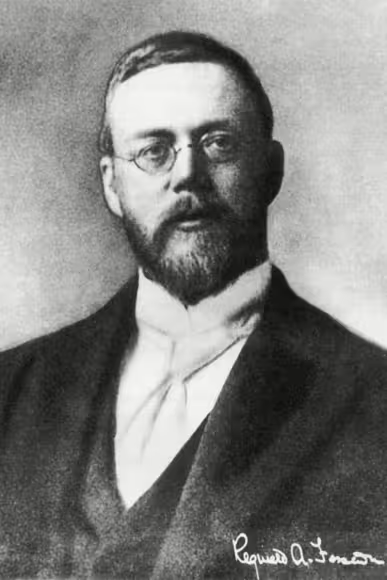
On October 6, 1866, Reginald Aubrey Fessenden was born in what is now Quebec, Canada. An inventor, engineer and teacher, he would help transform wireless communication from a means of sending coded signals into a technology capable of carrying the human voice.
From Teaching to Electrical Invention
Fessenden’s career followed an unusual path. As a young man, he taught in Canada and became principal of the Whitney Institute in Bermuda. His growing interest in science eventually took him to the United States, where he joined Thomas Edison’s organisation in 1886.
Working with electrical equipment gave him practical experience that complemented his curiosity and determination. He later held academic positions before joining the U.S. Weather Bureau in 1900 to investigate wireless communication.
Sending Speech Without Wires
Early radio systems primarily carried messages in Morse code. Fessenden wanted to transmit speech itself, allowing a listener to hear words directly rather than decode a sequence of signals.
On December 23, 1900, at Cobb Island, Maryland, he transmitted speech between two stations roughly a mile apart. The signal was noisy, but the experiment demonstrated that radio waves could carry a recognisable human voice. It is widely credited as the first transmission of speech by radio.
This was an important step in the development of radiotelephony: communication by voice over a wireless connection. Considerable further work was needed before the technology could become reliable and widely available.
Building the Foundations of Voice Radio
Fessenden continued developing methods for generating continuous radio waves and improving reception. His work on the heterodyne principle, which combines signals of different frequencies, became an important contribution to radio engineering.
These advances helped create the technical foundations for transmitting speech and music. Radio’s development involved many inventors, but Fessenden played a central role in demonstrating that wireless communication could carry more than coded messages.
An Inventive Life Beyond Radio
His interests also extended beneath the sea. The Fessenden oscillator, an underwater sound device capable of transmitting and receiving signals, contributed to early acoustic communication and echo-sounding technology.
Fessenden died in Bermuda on July 22, 1932. His legacy lies in the practical possibilities he helped reveal: voices travelling without wires and sound helping people understand the waters beneath their ships.
Other Events on This Day
- John Paul II Becomes the First Pope to Visit the White House
- The Moulin Rouge Opens in Paris and Begins Its Journey to Cabaret Fame
Credits: 1st photo: Unknown photographer / Harper’s Weekly, February 21, 1903, p. 298, via Wikimedia Commons. Public domain. Sources: National Park Service – Reginald Fessenden; IEEE – Fessenden and the Early History of Radio Science


