
Nov
8
8
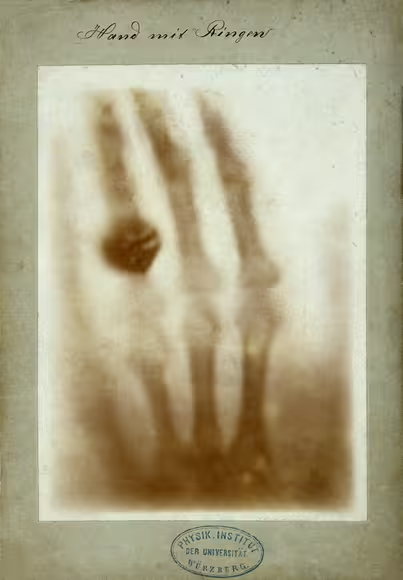
On November 8, 1895, German physicist Wilhelm Conrad Röntgen noticed something unexpected in his laboratory in Würzburg. While experimenting with a cathode-ray tube, he observed a nearby fluorescent screen glowing even though the tube was covered with thick black cardboard. The observation led him to identify a previously unknown form of radiation: X-rays.
An Unexpected Glow
The cardboard blocked visible light, yet something from the apparatus was still reaching the screen. Röntgen investigated systematically, testing how the mysterious rays behaved and which materials they could penetrate. He used the letter “X” to indicate their unknown nature.
Further experiments showed that the rays could pass through materials that were opaque to ordinary light. They also affected photographic plates, making it possible to record images of objects concealed from view.
Seeing Beneath the Surface
The implications for medicine were remarkable. Soft tissue allowed more of the radiation to pass through than bone or metal, creating contrasting shadows on a photographic plate. Doctors could obtain information about the inside of a living body without making an incision.
One of Röntgen’s most famous early images showed the bones of his wife Anna Bertha’s hand, together with the dark outline of her ring. Produced in December 1895, it offered a striking demonstration of the discovery’s possibilities.
Röntgen submitted his first report at the end of December. News spread quickly, and physicians began exploring how X-rays could help them identify fractures and locate foreign objects.
The First Nobel Prize in Physics
In 1901, Röntgen received the first Nobel Prize in Physics for his discovery. What began as an unusual glow in a laboratory had opened an entirely new field of investigation.
November 8 celebrates both the discovery itself and the careful experimentation that followed it. Röntgen’s work turned an unexpected observation into a tool that changed how doctors could examine and understand the human body.
Credits: 1st photo: Wilhelm Conrad Röntgen, 1895. Wellcome Collection, via Wikimedia Commons. Public domain. Digital restoration by Yann Forget. Sources: Nobel Prize — Wilhelm Conrad Röntgen: Biographical; Nobel Prize — Wilhelm Conrad Röntgen: Facts; American Physical Society — November 8, 1895: Roentgen’s Discovery of X-Rays


