
Nov
7
7
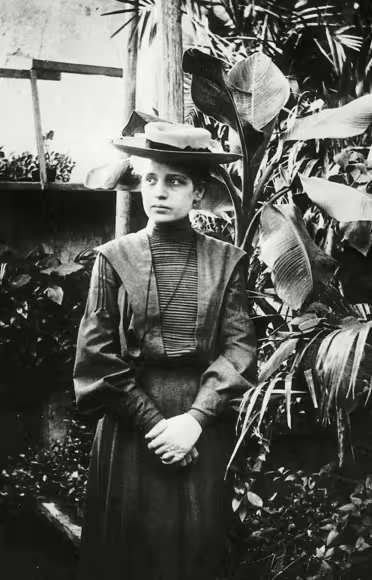
On November 7, 1878, Lise Meitner was born in Vienna, Austria. Through decades of research into radioactivity and the atomic nucleus, she became an important figure in modern physics. Her best-known contribution was helping explain nuclear fission: the splitting of a heavy atomic nucleus into lighter fragments.
A Determined Path into Science
Meitner studied at the University of Vienna, earning her doctorate in physics in 1906. The following year, she moved to Berlin, where she attended lectures by Max Planck and began a long scientific collaboration with the chemist Otto Hahn.
At a time when women faced significant barriers to university research, Meitner steadily established her reputation through experimental work. She investigated radioactive emissions and nuclear processes, eventually becoming a professor in Berlin in 1926.
Understanding an Unexpected Result
In late 1938, Hahn and fellow chemist Fritz Strassmann obtained surprising results from experiments in which uranium was bombarded with neutrons. Their chemical analysis identified barium, a much lighter element, among the products.
Meitner and her nephew, physicist Otto Robert Frisch, provided the explanation: the uranium nucleus could divide into two large fragments. They also accounted for the substantial energy released in the process.
Their interpretation appeared in Nature in February 1939. It connected the experimental findings with a physical mechanism and helped establish nuclear fission as a new field of scientific investigation.
Recognition and an Enduring Legacy
The Nobel Prize in Chemistry for 1944 was awarded to Hahn alone. Meitner did not share the prize, despite her essential contribution to understanding the discovery.
Other honours recognised her achievements. In 1966, she received the Enrico Fermi Award alongside Hahn and Strassmann. Element 109, meitnerium, was later named in her honour.
Her birthday celebrates scientific perseverance, collaboration and the insight needed to turn an unexpected experimental result into a deeper understanding of nature.
Credits: 1st photo: Unknown photographer, circa 1906. Courtesy of the Master and Fellows of Churchill College, Cambridge, via Wikimedia Commons. Public domain. Sources: Deutsches Historisches Museum — Lise Meitner; Nature — Disintegration of Uranium by Neutrons: A New Type of Nuclear Reaction; Nobel Prize — The Nobel Prize in Chemistry 1944; Royal Society of Chemistry — Meitnerium


