
Dec
24
24
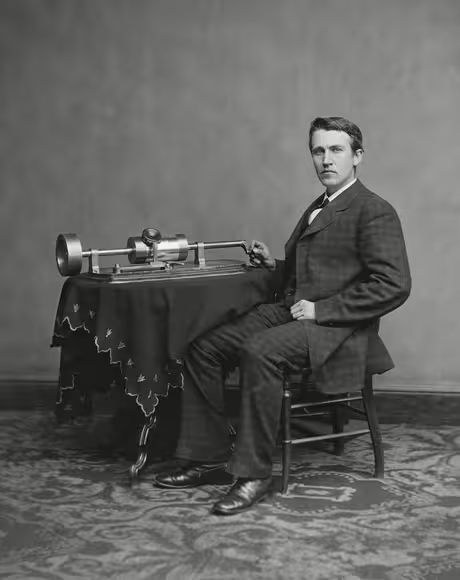
On December 24, 1877, Thomas Alva Edison filed a United States patent application for his phonograph, a machine capable of recording sound and playing it back. The application marked an important step in the history of an invention that would transform how people preserved voices, shared music and remembered the past.
A Machine That Could Speak Again
Edison developed the phonograph while investigating technologies connected with the telegraph and telephone. His experiments explored a remarkable possibility: could the vibrations produced by speech be recorded as physical marks and later turned back into audible sound?
At his Menlo Park laboratory in New Jersey, Edison and his assistants turned this idea into a working machine. Mechanic John Kruesi built an early cylinder phonograph from Edison’s design in December 1877.
How the Tinfoil Phonograph Worked
The early phonograph used a rotating cylinder covered with tinfoil. Speaking into a mouthpiece caused a diaphragm to vibrate, moving a recording point that pressed a pattern into the foil.
During playback, a reproducing point followed those impressions and caused a diaphragm to vibrate again. The machine converted the recorded pattern back into sound, allowing listeners to hear words after the speaker had finished speaking.
The recordings were fragile and could withstand only a limited number of playings. Nevertheless, the ability to store and reproduce a voice was an extraordinary demonstration.
Recording Was Older; Playback Was the Breakthrough
Edison was not the first person to record sound vibrations. Two decades earlier, French inventor Édouard-Léon Scott de Martinville had developed the phonautograph, which traced sound onto a recording surface but was not designed to play it back.
Edison’s breakthrough was a working device that combined recording with audible reproduction. His application became U.S. Patent No. 200,521, titled Improvement in Phonograph or Speaking Machines, on February 19, 1878.
Imagining a World of Recorded Sound
Edison envisaged uses ranging from dictation and recorded books to music, language teaching and the preservation of family voices. Many of these possibilities would become familiar features of everyday life.
The December 1877 application documented an early stage of that transformation: sound could now be captured, kept and heard again.
Other Events on This Day
- James Cook Reaches the Pacific Atoll That Became Christmas Island
- James Prescott Joule, the Physicist Who Transformed Our Understanding of Energy, Is Born
Credits: 1st photo: Photo: Levin C. Handy, c. 1878. Brady–Handy Photograph Collection, Library of Congress, via Wikimedia Commons. Public domain. Cropped and digitally restored; dust removal by Arad. Sources: U.S. Patent No. 200,521 — Improvement in Phonograph or Speaking Machines; Library of Congress — History of the Cylinder Phonograph; National Park Service — The Origins of Sound Recording; National Park Service — Origins of Sound Recording: Thomas Edison


