
Dec
24
24
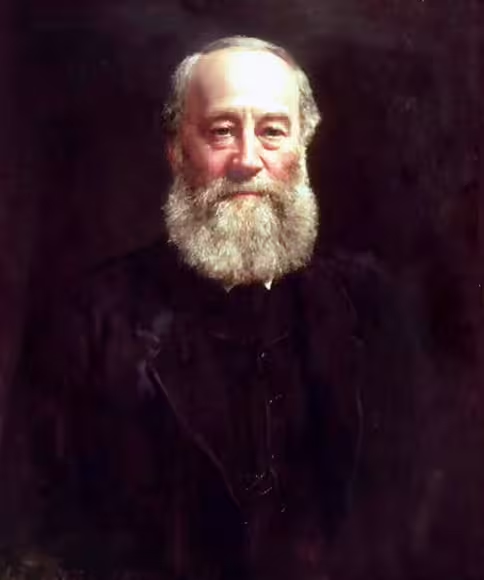
On December 24, 1818, James Prescott Joule was born in Salford, England. Through painstaking experiments, he helped establish that mechanical work and heat were connected by a measurable relationship. His research became central to the development of thermodynamics, and his name lives on in the joule, the international unit of energy.
From a Brewing Family to Experimental Science
Joule grew up in a prosperous family that operated a brewery. Educated initially at home, he later received tuition from John Dalton, the scientist closely associated with the development of modern atomic theory.
While working in the family business, Joule pursued experiments with electricity and magnetism. His early interest in electric motors led him towards a broader question: how were electrical power, mechanical work and heating related?
The Experiment That Made Water Warmer
Among Joule’s most famous investigations were his paddle-wheel experiments. Falling weights drove paddles through water inside a vessel. As the paddles stirred the water, its temperature rose slightly.
By measuring both the work performed by the weights and the temperature change, Joule established a consistent relationship between mechanical work and the resulting heating. Detecting such small changes required carefully calibrated instruments and close attention to heat exchanged with the surroundings.
These measurements provided powerful evidence against the idea that heat was simply a substance flowing between objects. Together with other researchers’ work, they helped establish the conservation of energy: energy can change form or pass between systems without being created or destroyed.
Understanding Electrical Heating
Joule also investigated how an electric current heats a conductor. His findings showed that the heating power depends on the conductor’s resistance and the square of the current.
Known as Joule’s law, this relationship helps explain both useful heating in electrical appliances and unwanted energy losses in wires and equipment.
A Name Written into Everyday Science
The unit joule, represented by the symbol J, honours his contribution to understanding energy. It provides a common measure for quantities encountered across mechanics, electricity and thermal physics.
Joule’s lasting achievement was to connect phenomena that could appear unrelated. A falling weight, warming water and an electric current became parts of the same measurable physical story.
Other Events on This Day
- James Cook Reaches the Pacific Atoll That Became Christmas Island
- Thomas Edison Files a Patent Application for the Phonograph
Credits: 1st photo: John Collier, 1882, via Wikimedia Commons. Public domain. Sources: The Royal Society — James Prescott Joule; Science Museum Group — James Prescott Joule; Science Museum Group — Mechanical Equivalent of Heat Apparatus; American Physical Society — James Prescott Joule and the Mechanical Equivalent of Heat


